
The ROI of Queue-it part III: Reducing scaling costs & cloud waste

What’s the return-on-investment (ROI) from using a virtual waiting room? In part three of our ROI series, we’ll explore how Queue-it helps organizations control scaling costs, reduce cloud waste, avoid expensive infrastructure upgrades and complex re-architecting, and block malicious traffic.
33%
average reduction in database scaling
costs
across 203 Queue-it customers
35%
average reduction in bot mitigation
costs
across 203 Queue-it customers
Handling peak traffic is not only complex—it’s also expensive.
Autoscaling makes costs hard to control and predict. Prescaling leads to overprovisioning and overpaying. And that’s if your systems actually can scale.
For many organizations, handling peak traffic requires significant re-architecting, upgrading or changing third-party services, setting up new processes like horizontal scaling, or changing key business logic.
In the first two parts of our ROI series, we explored how Queue-it saved a retailer over $1 million by protecting their brand and revenue, and how Queue-it saved a ticketing company almost $150,000 in staff and productivity costs.
In this piece, we’ll explore how Queue-it helps organizations control and reduce their cloud and infrastructure costs, showing how a fictional public sector org can save up to $2 million annually by using a virtual waiting room.
Many factors influence the technical cost of handling peak demand—your visitor count, user journey, tech stack, bottlenecks, third-party services, and more.
But across all industries, from small businesses to enterprises, we see the same common costs and challenges with handling peak traffic:
- Scaling for peak demand can require major system changes: Most systems are built for typical usage, not a sudden 5x or 10x surge in traffic. To handle these kinds of peaks, many organizations must change key processes, system design choices, third-party service providers, and more.
- Some bottlenecks are harder to scale: Most systems have a bottleneck, such as their database or a key microservice, which is some combination of: (1) unscalable, (2) extremely complex to scale, and (3) extremely expensive to scale.
- Overprovisioning and underperforming: Overprovision and you’ll pay for unused resources. Underprovision, and you’ll crash. Autoscaling may sound like the better solution, but it’s slow to react to sudden spikes in traffic and can create runaway costs as it aggressively scales up and fails to scale back down fast enough.
In short, handling peak traffic through scaling alone can be both risky and expensive. And when these traffic peaks are infrequent and temporary, it’s hard to justify.
“Autoscaling doesn’t always react fast enough to ensure we stay online. Plus, it’s very expensive to autoscale every time there’s high traffic. If we did this for every traffic spike, it would cost more than double what we pay for Queue-it.”
Mijail Paz, Head of Technology

Let’s look at how Queue-it can help manage both the costs and risks of scaling, using the fictional organization Unified Digital Public Services (UDPS) as an example. UDPS is a government agency responsible for planning and supporting digital service delivery and technical infrastructure for all public services in a country of 40 million people.
Before we dive in, let’s start with some details about UDPS's tech set-up and costs:
- Total annual cloud expenditure: $10,000,000
- Number of digital public services managed: 8
- Daily traffic across services: 260,000
Like most organizations, UDPS built their systems to handle their ordinary, day-to-day traffic, with a buffer to account for fluctuations in demand. But a few times a year, when their service appears in the news or they open a high-profile registration, traffic through UDPS’s systems exceeds their “ordinary” traffic levels, by up to 10x.
Before implementing Queue-it, these traffic spikes drove exponential scaling costs:
- Their database had a vertical scaling limit, requiring them to scale horizontally with a second database, costing an additional $50,000 per event.
- Autoscaling wasn’t quick enough to respond to these spikes, so UDPS prescaled (and overprovisioned) their servers, costing an additional $25,000 per event.
- They had to temporarily upgrade third-party services to ensure throughput guarantees matched expected traffic, costing an additional $10,000 per event.
Scaling for a single peak event, for UDPS typically cost $85,000, or $255,000 annually (three events).
When UDPS implemented Queue-it, they didn’t stop scaling for peak events. Instead, they used the waiting room to ensure scaling costs wouldn’t grow exponentially or get out of control.
Based on the results of our survey of 200+ Queue-it customers, Queue-it helped UDPS reduce their:
- Database scaling cost by 33%, or $49,500
- Server scaling cost by 37%, or $27,750
- Third-party services scaling cost by 100%, or $30,000
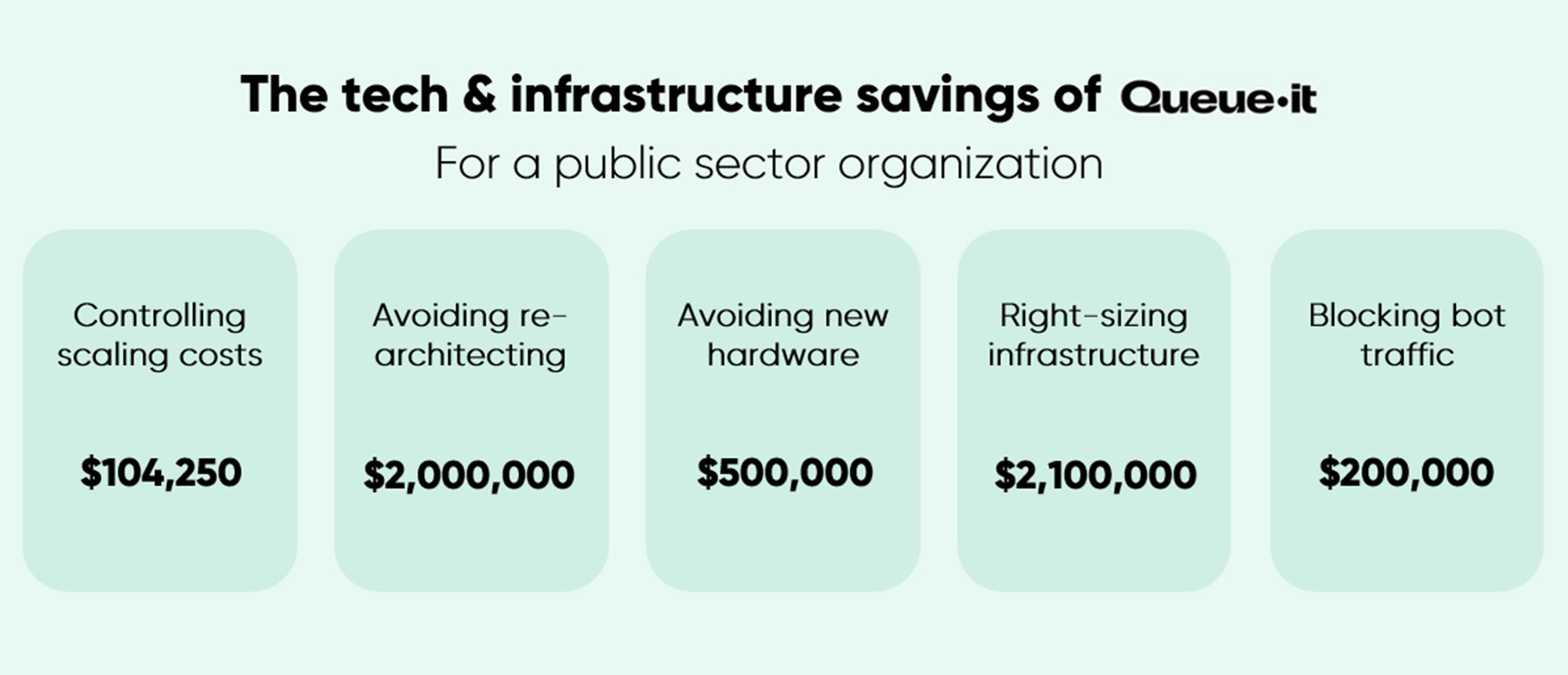
By using Queue-it for just three peak traffic events per year, UDPS saves $104,250 annually in scaling costs.
UDPS savings from implementing Queue-it
- Savings from controlling scaling costs: $104,250 annually
“It’s not trivial to scale systems. It’s not just about adding servers, it’s also about expanding the load balancers and working around bottlenecks or third-party dependencies that might also have similar scaling challenges … Queue-it saves us on scaling costs.”
Santiago Aguilera Moreno, IT Systems Architect

In the scenario above, we assumed UPDS could temporarily scale to handle extreme demand using their existing infrastructure and architecture.
But this is not the case for many of the organizations we work with. Handling a 10x traffic spike, for most organizations, requires a complete system redesign. And if services are hosted on-premises, it can involve massive investment in hardware.
Scaling a web system 10x is no easy feat. It often requires a major system overhaul, re-platforming, re-architecting, changing foundational business logic, and extensive testing—projects which can take thousands of hours of dev work and millions of dollars of investment.
For organizations like UDPS, whose systems work fine under ordinary conditions and who only experience extreme peaks three times a year, such an investment is not worth the time or money.
By implementing Queue-it to handle their extreme spikes, UDPS can handle their peak days confidently and serve every visitor without a massive re-architecting project, saving them up to $2 million.
"If you have peak demand scenarios like an iPhone launch, Queue-it is really a no brainer. It’s an easy win for successfully handling big events without investing huge amounts of money into re-architecting for peak traffic.”
Tom Grammer, Head of Mobile Services

UDPS manages one service which, due to government regulations, must be hosted fully on-prem. Twice per year, this service experiences an extreme spike in traffic, which repeatedly crashes their systems.
UDPS looked into purchasing new hardware to handle these traffic peaks, but between the hardware, set-up costs, software licenses, and network connections, the cost was over $500,000—for hardware that would just sit idle most of the year.
When UDPS implemented Queue-it, they set it up to protect this on-prem service by triggering the waiting room automatically when traffic reaches a set threshold, ensuring the flow of traffic to their systems never exceeds what they can handle.
By avoiding the investment in hardware that’s only needed twice per year, UDPS saves over $500,000.
UDPS savings from implementing Queue-it
- Savings from controlling scaling costs: $104,250 annually
- Savings from avoiding re-architecting: $2,000,000
- Savings from avoiding purchasing & maintaining new hardware: $500,000
“I spoke to some enterprise engineers and they said ‘Sure, we can fix this for you.’ But we’re talking about millions of dollars. That kind of money is just not in the budget ... to cover registrations that happen a few times a year … [Queue-it] allowed us to keep the same hardware and control the traffic, which was a great fit for our situation.”
Jut McDaniels, Registration Software Coordinator

On average, 27% of total cloud spend is wasted, and UDPS is no different. Before Queue-it, UDPS used reserved instances to ensure they could handle 40% more concurrent visitors than they see on a normal day.
This buffer gave UDPS extra confidence, and was useful during peak times, but it created a lot of cloud waste.
With Queue-it, the UDPS team cut that buffer down to 10% above “normal” levels, and set up a waiting room to monitor traffic to their site 24/7. Now, if traffic exceeds the threshold they’ve set, the waiting room activates and ensures visitors are sent to the site at exactly the rate it’s scaled for.
With 24/7 Peak Protection, UDPS’s waiting room activates slightly more often—appearing two-to-three times a month and giving select visitors a short wait period. But they reduce their traffic buffer from 40% to 10%, significantly cutting down on reserved instances, overprovisioning, and overall cloud waste.
Across the year, this initiative results in a 21% saving across their total cloud bill, which is the equivalent of $2.1 million saved annually (assuming a $10 million cloud bill).
UDPS savings from implementing Queue-it
- Savings from controlling scaling costs: $104,250 annually
- Savings from avoiding re-architecting: $2,000,000
- Savings from avoiding purchasing & maintaining new hardware: $500,000
- Savings from right-sizing infrastructure: $2,100,000 annually
“Paying for super scaled up infrastructure is pointless when we don't need it most of the time. Queue-it offered that extra level of security and the ability to control the traffic spikes. It’s a very cost-effective way of managing demand."
Kevin Lewis, Product Manager

After some time with Queue-it in place, UDPS reviewed their traffic data in the GO Queue-it Platform, identifying a significant amount of suspicious activity:
- 10% of their traffic comes from data centers
- 5% of their traffic comes from other countries (for services that should only be locally accessible)
- 3% of their traffic comes from the same IP address, which is constantly pinging their servers
To address this malicious and unwanted activity, the UDPS team used Queue-it’s Bots & Abuse features. They set up custom access rules to block the malicious IP address, block traffic from selected countries, and challenge all traffic from data centers—cutting their overall traffic by 10%.
By blocking this non-human traffic, UDPS cleaned up their analytics, reduced overall load, boosted their security, and reduced the frequency of activations of their waiting room.
Overall, by keeping malicious activity off their systems, UDPS saved $200,000 in annual cloud infrastructure expenditure.
(And if you already have bot mitigation in place, Queue-it can cut down the costs of that, too. By filtering traffic before it hits your website, Queue-it customers report an average reduction of 31% in their bot mitigation costs).
UDPS savings from implementing Queue-it
- Savings from controlling scaling costs: $104,250 annually
- Savings from avoiding re-architecting: $2,000,000
- Savings from avoiding purchasing & maintaining new hardware: $500,000
- Savings from right-sizing infrastructure: $2,100,000 annually
- Savings from blocking unwanted traffic: $200,000 annually
“Queue-it allows us to investigate traffic to work out where demand is coming from and whether it’s genuine. And if it isn’t, we can isolate it and put it in what I call IP jail. From a security perspective that’s crucial. It gives us the visibility and flexibility to act fast.”
Elaine Salveta, Digital Services Manager
Controlling the flow of traffic to your site doesn’t just reduce the risk of crashes and load-induced errors, it also reduces the cost of handling traffic spikes.
After years of trying to tackle peak demand through endless scaling, performance testing, and system changes, many customers describe the discovery of a built-for-purpose, bolt-on tool like Queue-it as a “lightbulb moment”. They realize the huge costs and resources required for scaling aren’t an essential ingredient in handling peak demand.
The exact infrastructure savings you’ll achieve with Queue-it will depend on a wide variety of factors, such as your traffic, use case, and architecture. But in our illustrative example with UDPS, they achieved savings of more than $2 million, both upfront and annually.
And these numbers are in addition to the $1+ million organizations can save by protecting their brand and revenue by keeping their website online, and the $150,000 they can save by reducing staffing costs and boosting productivity.