
How registration platforms ensure fairness & reliability on their biggest days

When registrations open, demand doesn't arrive gradually, it arrives all at once. For registration platforms managing multiple clients and unpredictable traffic spikes, that's a serious problem. Here's how leading platforms like Xplor Recreation, Girl Scouts of the USA, and Njuko use Queue-it to keep registrations running smoothly, fairly, and reliably.
Behind every summer camp, recreational class, and camping or hunting weekend lies a registration. Registration platforms power people's access to all these experiences, and many more
Every registration matters to three parties:
- The visitor, who wants to register themselves or their family for an experience
- The organization, which wants to deliver a fair and reliable experience for visitors
- The registration platform, whose services make the whole process possible
But when registrations become too popular, demand can overwhelm digital registration platforms, creating an unreliable and unfair experience for everyone involved.
The challenge is that demand for registrations doesn't arrive gradually. When slots are limited, visitors arrive in a rush, often within minutes of "registration opens." Those traffic spikes can overwhelm the systems that make registrations possible: login services, databases, payment gateways, seat and spot allocation, and third-party integrations.
Discover why major registration platforms like Xplor Recreation, Girl Scouts of the USA, Nap, Education Authority, and Njuko use virtual waiting rooms to protect these systems and handle demand during surging traffic, how these solutions work, and why it’s so hard to keep platforms running smoothly during large spikes in activity.
Registration platforms use a virtual waiting room (an online queue system) during high-demand registrations to protect their platforms and their customers from surging traffic, ensure fair access, and deliver a controlled and reliable experience.
Compared to single-brand sites, registration platforms face a unique challenge: they often support many clients, each with their own registration calendars, promotions, and peak moments—sometimes with little or no advance notice.
That creates three platform-level pressures:
- Peaks are hard to predict: Clients don't always know when a surge is coming, or can't warn you in time. A single social post, email blast, or deadline reminder can turn normal traffic into a wave.
- Fairness is a business requirement: In registration, perceived unfairness is as damaging as downtime. If people feel the system didn't give them an equal chance, because pages didn't load, payments failed, or the site froze, complaints escalate quickly. And those complaints don't stop with site visitors; they become client escalations.
- Concurrency limits compound across clients: Whether you're operating shared infrastructure or client-specific environments, you still have capacity ceilings: database throughput, application limits, API rate limits, payment providers, identity systems, and more. At peak, bottlenecks almost always appear.
These risks and their consequences aren't theoretical. High-demand digital registrations regularly become overwhelmed across summer camps, swim schools, hunting and camping, voting, education, and much more. These incidents drive complaints, bad PR, churn, and pressure from key stakeholders.
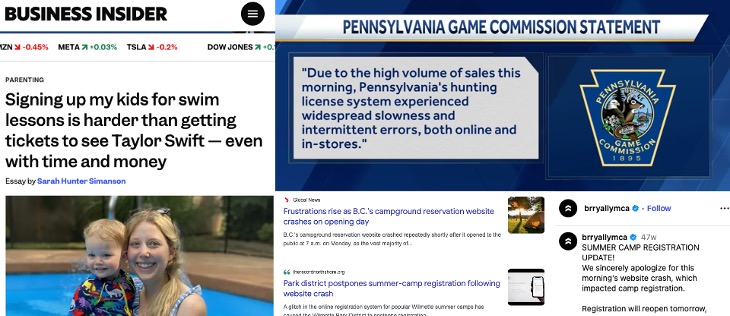
“We’d have 500 spots for a swim class and 5,000 people trying to get it. Everyone was hitting refresh and trying to book at the same time, which was just a nightmare experience ... We got a lot of angry comments on our social media sites.”
Jut McDaniels, Registration Software Coordinator

Virtual waiting rooms prevent these kinds of "nightmare experiences" for major registration platforms and local organizations across the globe.
They give platforms and clients complete control over registration traffic, enabling them to:
- Ensure platform performance: Virtual waiting rooms capture sudden surges in web traffic before they hit key bottlenecks, allowing you to control the rate at which visitors get access to ensure you never exceed the technical capacity of your systems.
- Improve visitor experience: Waiting rooms replace the frustrating experience of a website crash or slowdown with transparent and controlled access, including detailed wait information on a branded page that can feature important info like registration deadlines and necessary documentation.
- Deliver fair access: Waiting rooms provide sophisticated fairness mechanisms by ensuring first-come-first-served site access and allowing visitors to get notified when it’s their turn.
“As we take on bigger clients, that extra level of protection becomes critical. It’s so valuable as a business to be able to say to a client, ‘We can assure you we won’t crash’. Queue-it gives us the confidence to say that.”
MATT TREVETT, HEAD OF U.K.

Virtual waiting rooms work by automatically redirecting online visitors to a waiting room when they enter a protected part of the user journey, for example visiting a landing page or proceeding to a registration form.
Visitors are seamlessly flowed from the site or page to a branded waiting room like the one below, where they see their number in line, their estimated wait time, and a progress bar. They experience a short, informed wait, then are flowed back to the protected action at the rate the system can handle in a fair, controlled order.
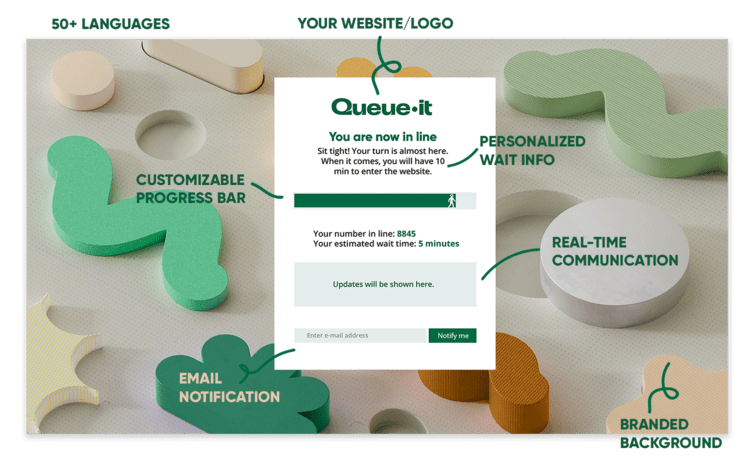
While organizations often customize their waiting rooms both in style and in URL to look like the original site, the visitors in them are hosted on the virtual waiting room provider’s servers. This means no strain is placed on the target website or platform's infrastructure while visitors wait for access.

Controlling the flow of traffic not only keeps your registrations running smoothly, it can also save you and your clients time and money. In a recent survey, Queue-it customers reported a 38% decrease in server scaling costs and a 51% decrease in the number of staff needed on-call during registrations.
Queue-it customers report a 38% decrease in server scaling costs and 51% decrease in the number of staff needed on-call during registrations.
Xplor Recreation (formerly PerfectMind) offers all-in-one recreation management software for government agencies and private recreation facilities—supporting registrations for everything from martial arts studios to homeowner associations to swim schools.
Now serving over 140 global markets and 75,000 daily visitors, Xplor uses Queue-it's virtual waiting room to ensure fair, reliable experiences during their biggest registrations.
Nap, Japan’s largest campsite search and reservation organization, uses Queue-it to control demand during high-traffic campsite reservation openings, keeping its platform stable while giving visitors a fair, orderly path to book.
Queue-it helps Nap deliver smoother registration experiences, reduce infrastructure strain, and handle recurring demand peaks with greater confidence.
"Regulating outflow per session significantly mitigated the burden on our infrastructure. In the long run, I think this will reduce the cost to maintain our infrastructure. We used to endlessly add servers, but with Queue-it, we will be able to enhance servers in a more planned and efficient way."
System Development Engineer, Nap
Education Authority (EA) is responsible for primary and secondary education services in Northern Ireland, working with over 1,700 schools and providers to process around 70,000 school applications each year.
EA uses Queue-it to manage high demand during key online school admissions dates, helping maintain consistent performance while giving parents and guardians a fair, transparent application experience. Queue-it also helps reduce pressure on support teams by clearly communicating why visitors are waiting and controlling how many users complete applications at once.
"We decided to implement Queue-it at key dates in the admissions process. It gave us the reassurance that the user traffic would be managed in an efficient way with the use of the virtual waiting room. It also allowed us to limit the number of users who were able to complete the application at any one time which resulted in an improved user experience."
Education Authority Digital Transformation Team
Scaling helps. But no amount of scaling eliminates the risk entirely.
There is no “too big to fail” in the world of websites. Amazon, Walmart, Apple, the IRS—surging web traffic has taken all of them offline.
The key challenge for registration platforms is that they operate across a wide range of clients, each with their own unpredictable peak moments.
Autoscaling is the typical approach to handle this unpredictability. But as Matt Trevett from Njuko explains, “A lot of registration platforms rely on autoscaling to handle uncertain traffic in high-demand situations. And we’ve seen a lot of them crash because of that."
Scaling alone is expensive at best, and risky at worst. It can be:
- Expensive: Most systems are built to perform optimally under their typical volume of traffic. Building a platform that can handle huge traffic peaks that only come a few times a year is like buying a house with 10 extra rooms because your family comes to visit sometimes—it’s expensive, impractical, and unnecessary.
- Reactive: Because traffic levels are hard to predict and autoscaling takes time to kick in, your systems likely won’t be ready in the critical moment they’re needed.
- Risky: Even if autoscaling or pre-scaling could handle these surges, bottlenecks almost always emerge. This means traffic still overloads areas that are difficult or impossible to scale, such as databases, inventory management systems, or third-party features like payment gateways.
A virtual waiting room complements your autoscaling approach and gives you confidence by controlling what other crash-prevention tactics can't: the flow of traffic.
Trevett from Njuko explains how his team combines tactical scaling with Queue-it to keep their platform online while keeping their costs under control:
“We always pre-scale to a place where we know we’ll be able to handle the expected traffic. Then in case of anything unexpected, we have Queue-it on top that as a safety net. This gives us full confidence we won’t go down, but it also lets us give a quote guarantee to clients, because we know the system isn’t going to autoscale like crazy and cost a huge amount.”
Peak registration moments are where clients decide whether your platform is reliable, or risky.
When registrations run smoothly, you don't just create happier end users. You create more confident clients, fewer escalations, and a stronger story for renewals, expansions, and new business.
If you want to run successful registrations without overbuilding infrastructure for rare peak moments, a virtual waiting room gives you control, fairness, and predictability when it matters most.