
King’s College London’s solution for fair & reliable housing registration

Home to over 30,000 students, King’s College London is renowned for its prestigious history, research, and student experience. But during student housing registrations, huge online demand was bringing King’s student experience under threat, crashing and slowing down their residential management system. Discover how King’s used Queue-it to overcome these challenges and improve the student experience without spending a fortune on scaling.
100%
uptime
for thousands of students on one of their first touchpoints with KCL
80%
fewer support requests
making housing registrations less stressful on IT & support staff
Founded in 1829, King’s College London is one of England’s oldest and most prestigious universities. With over 30,000 students, King’s mission is “to make the world a better place”. To that end, they have an ambitious vision for 2029 (their 200th anniversary) that involves several transformative initiatives, including to “extend reach, expand access, and deliver an extraordinary student experience.”
For Steve Barlow, King’s Physical Environments Systems Manager, “the aspiration is to consistently provide the best service we can. My team and I are always looking for service improvements to give more value to our customers and improve the student experience.”
But for several years, King’s housing registrations—a key moment in the student journey—wasn’t living up to King’s standards nor their vision to become leaders in the student experience.
Large and sudden surges of students logging in to reserve housing often overwhelmed their residential management system (RMS), leading to site crashes, slowdowns, and an overwhelming number of frustrated calls to the customer service team.
Discover how King’s teamed up with Queue-it to overcome these challenges and ensure that one of their first touchpoints with students matched the world-class experience the university strives to deliver.
Each year, shortly after students receive their offers to study with King’s, the Physical Environments team opens applications for student housing. With thousands of students eager to secure housing, the portal, which opens at a fixed time, quickly gets flooded with visitors.
“When we opened applications, we’d get four to five thousand students hitting our server all at once, and our residential management system just couldn’t handle it,” says Stuart Fraser, IT Lead for Physical Environments. “The portal would crash, and we’d get inundated with phone calls from students complaining about the website. We’d jump from an average of 50 customer service calls a day to well over 1,000 on the day we opened applications.”
“It’s one of the most important days for our students and among their first real touchpoints with King’s as a university,” says Stuart. “To have our system crash didn’t reflect the kind of experience students could expect with us or that we strive to deliver. We knew improving the student experience in this area was key for the university.”
The team tried several solutions to prevent these load-induced crashes and minimize the initial traffic spike, Stuart says. “We set up time slots, but the students ignored them. We looked to optimize the booking process, but our RMS provider had a fixed throughput limit, and they couldn’t increase it. We explored scaling, but we couldn’t justify the hardware expense it would take to handle the traffic when we only need it for one day a year.”
“We’re a small team, so these problems put a lot of pressure on us,” says Steve. “The students weren’t happy, the business wasn’t happy, the service desk wasn’t happy, and neither were we. We all knew we needed a fix—we just didn’t know technically what that fix would be.”
That was until King’s IT director came to the Physical Environments team one day with a suggestion, says Steve. “He’d seen another leading U.K. university use Queue-it to solve the challenges we’d been having, and that’s when we started considering a virtual waiting room.”
The team looked into Queue-it’s virtual waiting room and quickly realized that by controlling the flow of traffic into their application portal, they could solve their troubles with peak demand.
They took the solution to Dave Pople, Head of IT Supplier Management for King’s, who was pleased to find Queue-it was available to purchase through the U.K. Government’s G-Cloud 14 framework.
“The fact that we could procure Queue-it through G-Cloud made our lives a lot easier, because a lot of the terms and conditions are pre-configured,” says Dave. “We could quickly see the service Queue-it offered, the terms and conditions of that service, and that it was a trustworthy solution that could support our needs.”
Once approved, the Physical Environments team worked with Queue-it’s “very helpful” team to get the virtual waiting room up and running.
They shut down the applications portal in the days leading up to go-live, replacing it with a brief description of the application process and the time it would open.
When applications opened, “the spike in visitors was directed straight into the waiting room,” says Stuart. “From there, we were able to keep our systems running smoothly by sending students through to our booking site at the rate it could handle.”
“The improvement to the student experience was immediately clear by dramatic reduction in calls to the service desk compared to previous years. Calls dropped by about 80%, so the service team were quickly singing the praises of Queue-it.”
Stuart Fraser, Physical Environments IT Lead

“The fact that there was an estimated wait time, an explanation for the wait, and that we could send real-time messages, meant students didn’t really call to ask questions,” says Steve. “They understood and accepted what was going on in a way they didn’t in previous years.”
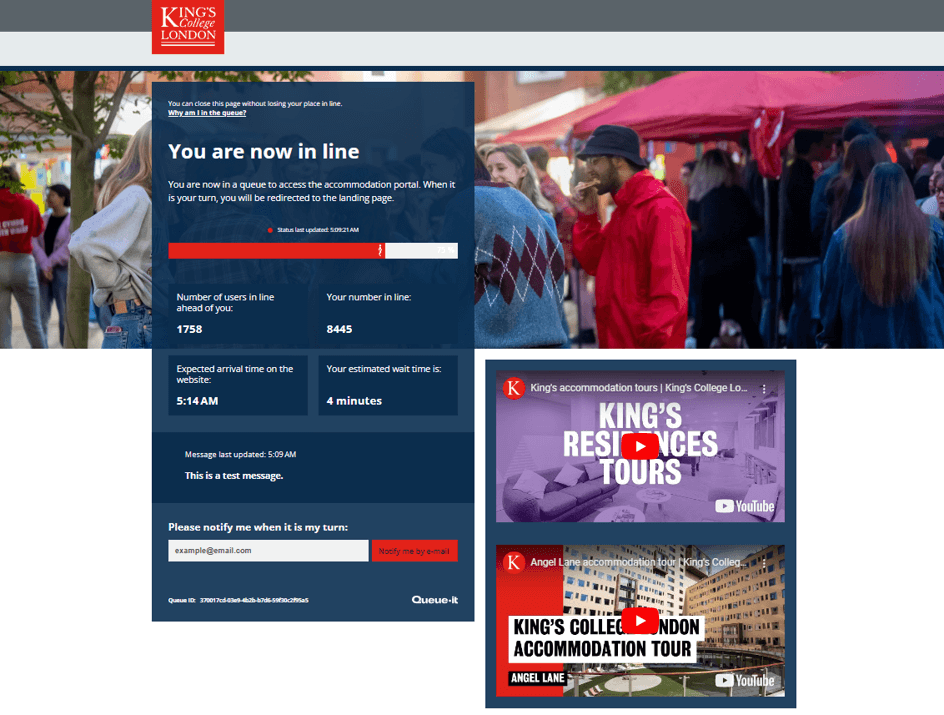
King's College London's waiting room custom theme with real-time messaging and embedded videos of accommodation tours
But it wasn’t just the students and service team that Queue-it helped. For the Physical Environment’s team, the ability to control traffic in real-time allowed them to act fast when the unexpected occurred, says Stuart.
“In our most recent round of applications, our supplier contacted me letting me know the system was slowing down and they couldn’t do anything about it. I hopped on the GO Queue-it Platform, paused the queue, and sent out a real-time message explaining the reason for the pause. Once the systems cooled off, I could immediately un-pause the queue and keep sending visitors through to the site, without people losing their place in line or having to re-start the process.”
“When this happened before Queue-it,” Stuart continues. “I’d have to contact the vendor, who would usually say ‘Resources are at 100%, we can’t do anything.’ Then my only option was to do a system reset, which would frustrate visitors even more—especially those who were halfway through their booking process. Back then it was just a waiting game for traffic to drop to a level we could handle, but with Queue-it, we can actually act when something goes wrong and can keep students informed.”
“If you have a website resource that struggles to handle peak traffic, then Queue-it is a must-have. You can manage the traffic, you can manage the expectations, you can manage the overall experience.”
Steve Barlow, Physical Environments Systems Manager
For public institutions like King’s, it’s important to strike the right balance between delivering meaningful new service improvements and effectively allocating spending. For the Physical Environments team, Queue-it struck that balance, allowing them to improve their student experience without exorbitant expenditure.
“We couldn’t justify purchasing new hardware and investing in scaling when it wasn’t needed for 364 days of the year. Queue-it is a more cost-effective and built-for-purpose solution that just makes sense.”
Steve Barlow, Physical Environments Systems Manager
After the significant improvements to their booking process, the team are already recommending Queue-it to other internal departments, Steve says. “There are several other web services at the university, such as class registration and acceptance, that face this same challenge of traffic peaks that only occur a few times a year. We’re exploring implementing Queue-it there to support those processes, too.”
“Even as we migrate to a new RMS system,” Stuart says. “We’re planning to keep Queue-it in front of the booking system. The confidence and control it gives us in the face of the unexpected is invaluable.”