
AI ticketing: How AI agents are changing the way fans find and buy tickets


AI ticketing changes how fans discover, compare, and buy tickets. As events and live inventory become visible through AI assistants, ticketing companies are integrating with conversational platforms and exploring how agents could move from recommendation to payment. But this next phase of ticketing also raises important questions about trust, authorization, transparency, and fair access.
Ticket buying is becoming more conversational. Fans no longer have to start their search on a ticketing site or in a search bar. They can ask an AI assistant to find them a show, compare seats, and check prices, all in the same conversation.
Ticketmaster has already rolled out live integrations with Claude, ChatGPT, and Gemini, and has expanded to Amazon Alexa+, letting fans discover concerts, sports, and theater events through natural conversation instead of a traditional search. Other ticketing platforms, including SeatGeek, have launched similar integrations.
So far, most of these experiences stop at recommendations: the AI assistant helps a fan find and compare events, then hands them off to a ticketing marketplace to complete the purchase. But AI ticket booking is already moving beyond that.
In the U.S., some Ticketmaster customers can go a step further, letting an agent prepare or even complete a purchase on their behalf. A sign that ticketing is moving from AI-assisted discovery toward systems that can act, and potentially pay, for fans.
Table of contents
AI ticketing covers any use of artificial intelligence to help fans or ticketing operators make decisions. Agentic ticketing is a more specific idea within that: it's when an AI system can act on a fan's behalf, not just assist them.
There's an important distinction to keep in mind as the sector evolves:
- AI-enabled ticketing includes recommendations, chatbots, demand forecasting, fraud detection, customer service automation, and pricing models.
- Agentic ticketing means an AI system can act on a fan's behalf: interpret preferences, search inventory, compare options, monitor availability, and potentially initiate or complete a transaction.
Looking across the market, the sector appears to be progressing through three stages:
- AI-assisted discovery, where assistants help fans find events that match what they're looking for.
- AI-assisted comparison and monitoring, where assistants track prices, seating, and availability over time.
- Agent-initiated or agent-executed purchases, where the assistant moves from suggesting options to acting on them.
Most large-platform announcements today still emphasize the first two stages. While a smaller number of ticketing providers are explicitly promoting the third as soon-to-be capability.
Fans can now run conversational searches based on budget, location, date, genre, seating preference, or occasion — the kind of multi-criteria search that used to take several clicks and filters on a ticketing website. Ticketmaster's previously mentioned integrations show how quickly ticket inventory is moving into the AI environments fans already use every day.
But it's not just Ticketmaster racing into the AI spaces.
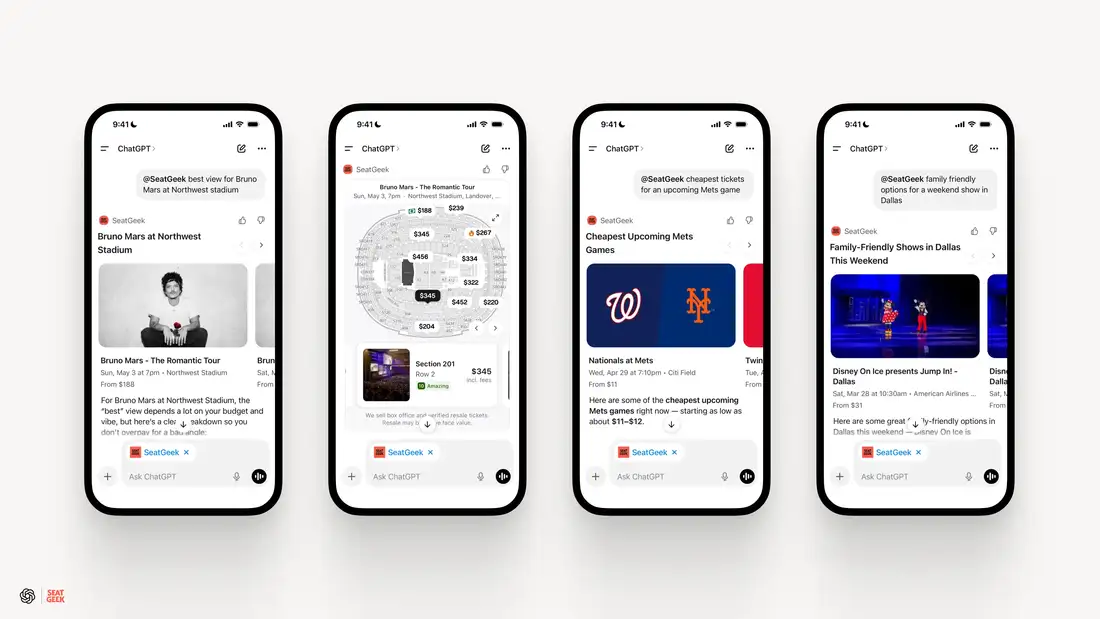
SeatGeek started by joining the AI search pilot alongside Ticketmaster, enabling conversational ticket discovery inside Google Search in 2025. Then it launched primary ticketing inside Spotify across 15 major US venue partners in early 2026, with its ChatGPT integration following shortly after.
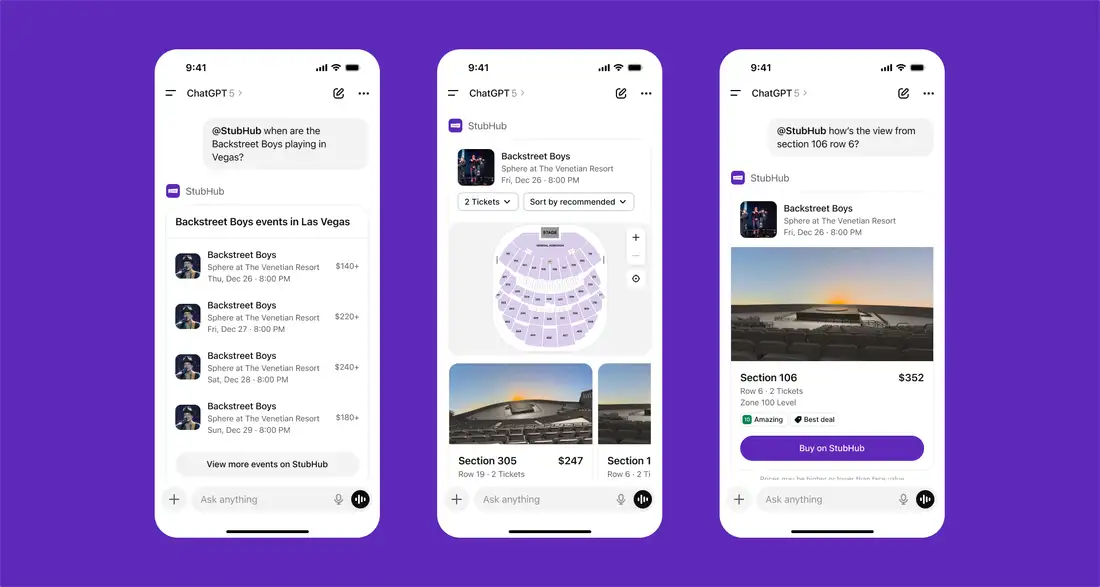
StubHub entered the race with its ticketing-finding assistant in ChatGPT at the end of 2025, with conversational refinement and its own trust signals.
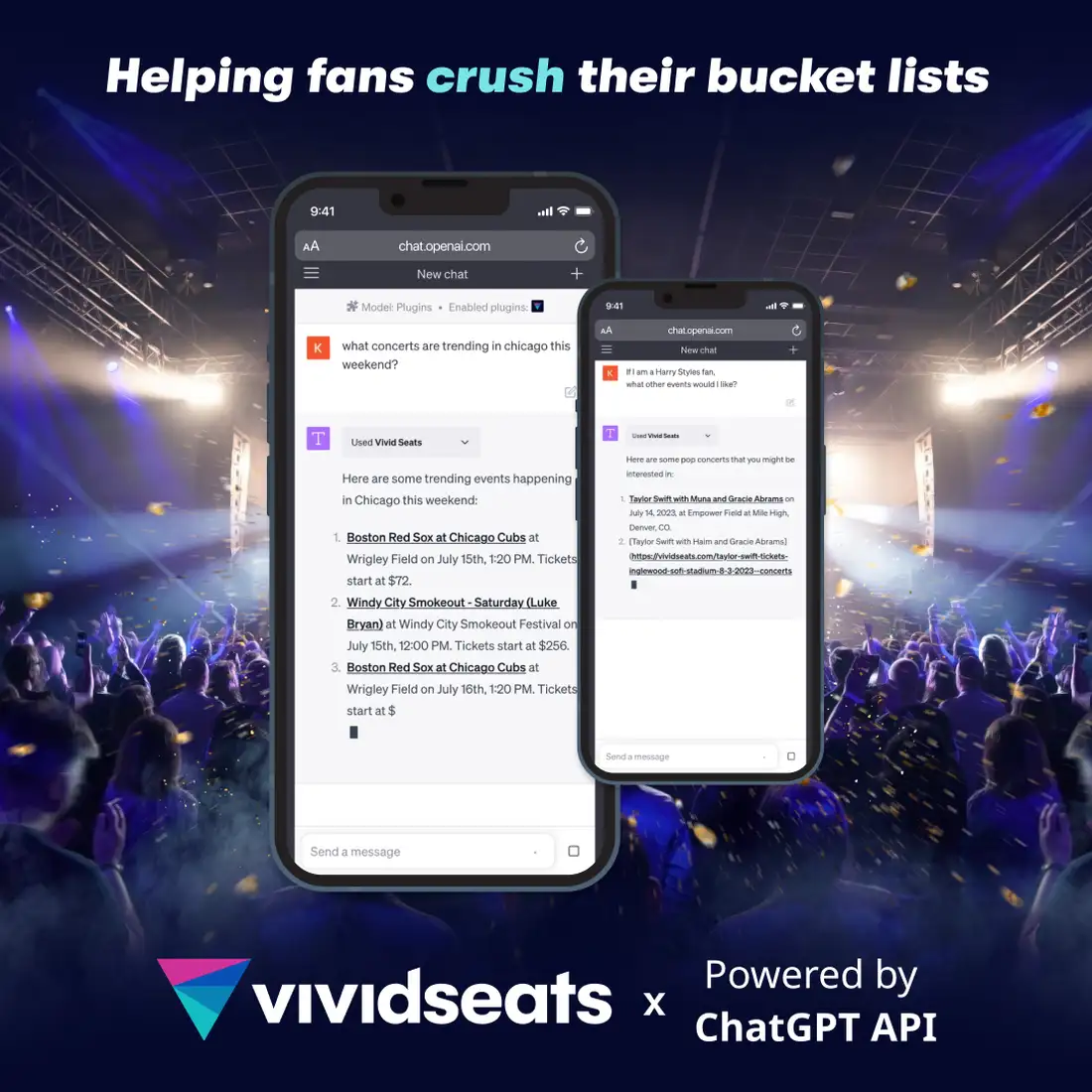
Back in 2023, Vivid Seats announced the first live-events ChatGPT plugin, well before this wave.
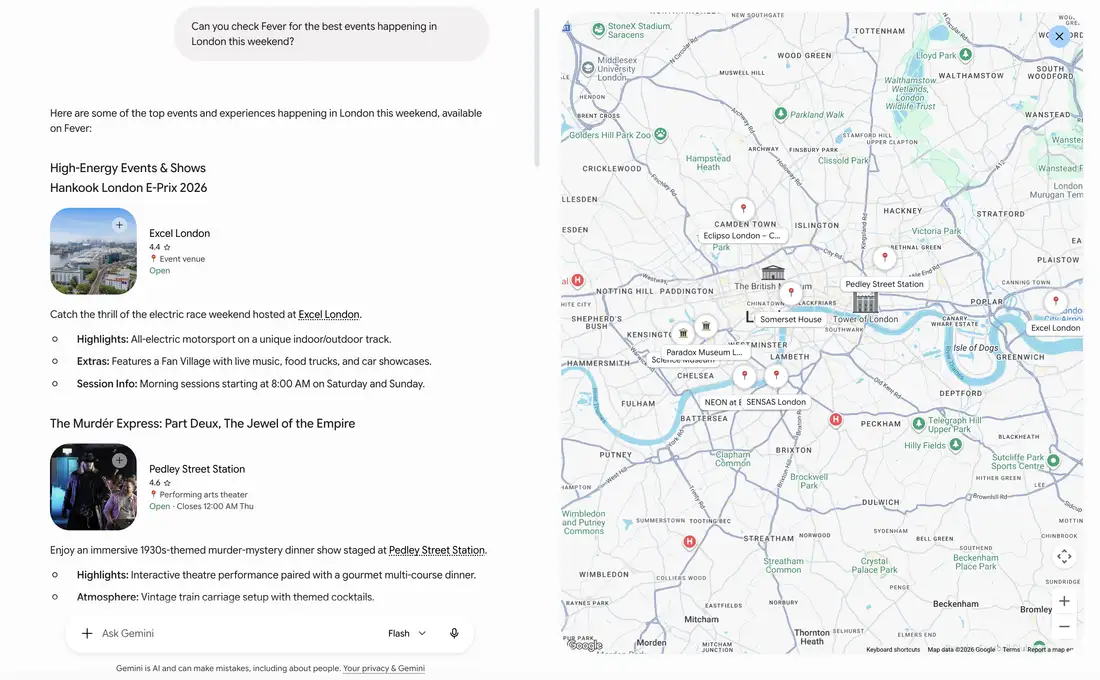
Fever joined Gemini in August 2026 and separately runs its own MCP server giving Claude and other compatible assistants direct catalog access, plus participates in OpenAI's ad pilot.
These moves show AI agent integrations are becoming table stakes across the sector, not a lasting differentiator for any one platform.
Most current experiences still send the fan to the ticketing marketplace to complete the purchase, keeping the transaction, and the trust that comes with it, on the ticketing company's own platform — for now.
Across Claude, ChatGPT, Gemini, and Alexa+, and more, AI assistants can increasingly:
- Interpret a fan's request in natural language.
- Retrieve relevant events.
- Surface live inventory and ticket information.
- Compare prices, seating, and availability.
- Refine results through follow-up questions.
- Hand the fan off to a ticketing platform to complete the purchase.
This turns ticketing into a more distributed model, where discovery begins outside the traditional marketplace, and the platform's job shifts from attracting visitors to being reliably visible wherever fans start asking questions.
But the discovery is only half of the story. The more interesting question right now is what happens after the AI assistant finds the event: does the fan still have to do the buying, or can the agent start doing that too?
Three models are emerging for how a purchase gets handled:
- Recommendation: the fan chooses and completes the purchase themselves.
- Pre-authorized, request-and-fulfill purchase: the fan sets criteria and payment details in advance, and the system completes the purchase automatically if it can be fulfilled, without a real-time confirmation step.
- Autonomous, agent-initiated purchase: an AI agent interprets the fan's intent, decides what to buy, and completes the transaction within limits the fan set in advance.
The industry is closer to the second model than most people probably assume.
Ticketmaster's own ticket request system in the US already works this way: fans submit their preferences and payment details up front, and if the request is fulfilled, the card is charged automatically, with no further approval needed to complete the purchase.
It isn't an AI agent doing the requesting yet, but the underlying trust model — intent set in advance, payment pre-authorized — is exactly what a fully agentic ticketing booking would need to work.
Fully autonomous purchases, where an AI agent itself interprets a request and decides what to buy without that kind of advance setup, are the bigger leap.
They also introduce more complex questions about identity, authorization, payments, and accountability.

As agents take on more of the ticket-buying journey, a handful of open questions become harder to treat as secondary.
The core problem isn't whether an agent can act; it's whether a platform can confirm it should. A fan might set a budget, a seating preference, or a purchase window, but once an agent is executing on those instructions, the ticketing platform has no reliable way to verify that the request in front of it actually reflects what that fan authorized, versus a misconfigured setting, a compromised account, or an agent overstepping its limits.
Research from Commercetools and Checkout.com found 65% of U.S. consumers trust AI to compare prices, but only 14% trust it to place orders autonomously, a gap that reflects exactly this unresolved authorization problem. Closing it will likely mean platforms need infrastructure that can authenticate a request's origin and permissions in real time, not just its behavior, before granting it access to inventory.
RELATED: How to trust an AI agent with AWS Alexander Günsche and Queue-it's Moji Sarooghi
Bad bots already account for roughly 40% of ticketing traffic. The problem is that an agent genuinely shopping for a fan and a bot built to scalp tickets can generate nearly identical signals: fast requests, repeated queries, no typical "human" friction. Telling the two apart accurately, without punishing genuine fans, calls for traffic differentiation that goes beyond behavioral heuristics, an area where waiting room and bot management technology purpose-built for this exact distinction becomes essential rather than optional.
Agents can query availability and submit requests at a speed and volume no human can match, which tilts access toward whoever has the most sophisticated automation, not necessarily the truest fan.
If agentic purchasing scales without guardrails, that imbalance risks getting worse, not better. Fair access at this scale means enforcing purchase limits per verified identity rather than per session, and queuing every request, human or agent, on equal footing. This is precisely the kind of fairness a virtual waiting room is designed to enforce: a level playing field where speed of arrival doesn't override the fairness of the queue.
Even with trust and fairness safeguards in place, ticketing platforms still need to contend with sheer timing. If thousands, or millions, of fans have agents pre-programmed to buy the moment an event goes on sale, those agents won't arrive the way a crowd of humans typically does. They'll deploy within the same second, all hitting the same limited inventory and the same backend systems at once.
That kind of synchronized demand is a different problem than a typical traffic spike, less about total volume and more about how fast that volume lands, and how much pressure it puts on payment gateways, inventory checks, and databases in a single instant.
As Queue-it's CPTO Hans Skovgaard has pointed out, agentic traffic isn't just more traffic; it's fundamentally different traffic: always on, operating at machine speed, and capable of acting at scale in ways that put far more pressure on peak events than human demand alone. Handling that requires infrastructure built to absorb and pace synchronized demand rather than just capacity built to handle more of it, which is exactly the role a virtual waiting room plays.
With the continuing rise of AI agent integrations, ticket sellers are no longer competing only for search engine rankings and website visits. They also need their events to be understood, surfaced, and accurately represented by AI systems — a new kind of visibility that depends on machine-readability as much as marketing.
Getting that representation right starts with a few practical steps:
- Keep event details, availability, pricing, seating information, restrictions, and official-seller status clear, current, and structured, using formats AI systems can parse reliably rather than scrape from a page.
- Support the protocols AI assistants use to pull live data, such as Model Context Protocol–based connections, so eligible events surface automatically instead of depending on manual updates.
- Monitor how your events actually appear across AI assistants, the same way you'd monitor search rankings, since incomplete or outdated information can lead to poor recommendations or leave an event out of AI-generated results entirely.
But visibility is only half the equation. When an AI assistant surfaces the wrong price, the wrong seat, or an unofficial reseller as if it were the primary marketplace, the fan has no easy way to know they've been misled until it's too late. And as more of the discovery journey moves off a ticketing platform's own site and into third-party AI assistants, platforms lose some direct visibility into how their inventory and pricing are being represented, which makes questions about who's accountable for inaccurate information harder to ignore.
Rebuilding that accountability starts with the same underlying data discipline: real-time, structured feeds on availability and pricing that both fans and AI systems can trust, backed by infrastructure that can validate a request the moment it hits the system rather than after the fact.
None of these are reasons to slow down AI ticket booking. But they are reasons it needs infrastructure built for both human and agentic traffic, not just clever integrations layered on top of the systems ticketing companies already have.
The future of ticketing is unlikely to be defined solely by whether an AI agent can buy a ticket. The more important question is whether the surrounding experience can remain accurate, transparent, trustworthy, and fair as agents take on more of the journey.
That future is already taking shape. Ticketmaster, SeatGeek, StubHub, Vivid Seats, Fever, and others are no longer experimenting with AI agent integrations. They're competing to be the ones fans find first, inside whichever assistant they happen to be talking to. As that race matures, discovery will keep moving off ticketing sites and into conversational interfaces, and pre-authorized purchasing may become the default rather than the exception.
An agent that can find and buy a ticket faster than any fan doesn't automatically make the process fairer, safer, or more accurate; it just makes the stakes higher if those things aren't built in from the start. The platforms that get this right won't be the ones with the flashiest agent integration, but the ones that can prove, in real time, that the traffic hitting their systems, human or agentic, is legitimate, authorized, and treated fairly.
Queue-it is already testing what that readiness looks like: a recent proof of concept with DNP and Meeco put humans and AI agents in the same queue for the same limited inventory, verifying each agent's mandate to act before it ever reached the front of the line. It's an early step, not a finished product, but it's a real preview of the trust-verified, identity-aware access that ticket sales at scale will need as agentic purchasing moves from theory to routine.
This shows that it's a feature to launch rather than infrastructure to build; it's the piece of this shift that will separate ticketing platforms that merely adapt to agentic traffic from the ones that are ready for it.