
Online traffic orchestration: Controlling traffic to power trust

Bot and agentic AI traffic is making online demand harder to read, harder to predict, and harder to control. Online traffic orchestration gives you the tools to take back control. Discover what it is, how companies use it, and where it fits in your stack.
A website can be fast, available, and secure, yet still fail the people it was built to serve. Genuine visitors can lose access to bots, critical journeys can break down, and infrastructure can scale to serve traffic that delivers little value.
Existing performance and security tools are indispensable. But they do not answer a fundamental question: how should access be governed when demand, intent, and capacity do not line up?
With the steady rise of automated (bot) traffic, and more recently, the huge surge in agentic AI, this question has become an increasingly critical one. As bots and agents make online traffic more complex and unpredictable, who or what should get access, when, and under what conditions matters more than ever.
Online traffic orchestration gives you real-time visibility and control over the traffic accessing your web applications. It uses identity, intent, and context to shape access in line with your business goals, system capacity, and security needs.
Table of contents
- The risks of uncontrolled traffic
- What is online traffic orchestration?
- How do organizations use online traffic orchestration?
- Where online traffic orchestration fits in your tech stack
- Online traffic orchestration in the age of agentic AI
Online traffic has always been unpredictable. Volume fluctuates, visitor intent varies, and the systems serving that traffic operate within fixed limits, whether that's infrastructure capacity, inventory, or third-party dependencies.
But the rise of automated traffic over the past decade, and agentic traffic over the past two years, has heightened both the complexity and the unpredictability of online traffic:
- 53% of all web traffic now comes from bots
- Agentic AI traffic grew 7,851% YoY in 2025
Bots and agents do not behave like the humans most websites were built for. They arrive and shop faster, in higher volumes, at precise moments. They amplify the existing constraints and limitations of web applications, while also creating new challenges:
- Limited visibility into who or what is accessing your applications: Without a clear view of traffic composition and behavior, organizations struggle to distinguish legitimate visitors from unwanted or higher-risk traffic.
- Inability to apply the right access rules: Loyalty members, staff, suspicious visitors, bots, and AI agents should not always be handled the same way. Without orchestration, access is governed by technical availability rather than intent, risk, fairness, or business priority.
- Inefficient use of capacity and infrastructure spend: Unwanted traffic and unnecessary sessions consume resources every day. Uncontrolled traffic drives avoidable scaling and overprovisioning, making it harder to align infrastructure investment with valuable demand.
- Critical journeys and experiences remain vulnerable: Bottlenecks like login, payment gateways, or inventory systems can be disrupted or abused through automation. During traffic surges, these weaknesses compound into higher costs, degraded experiences, unfair outcomes, or downtime.
Online traffic orchestration provides real-time visibility and control over the traffic hitting your web applications. It uses identity, intent, and context signals to decide how visitors are routed, gated, or managed, adapting access to match your business goals, system capacity, and security needs.
Think of a busy concert or sports event. There are ticket, ID, and bag checks. Lane dividers for the queues. Fast-track lines and secret entrances for staff or performers. Off-limits areas. Ushers and crowd control managers guiding the flow of people. Signage providing key information. Security monitoring for suspicious behavior.
Getting these thousands of people to their seats successfully, smoothly, and safely is a sophisticated act of visitor orchestration. It’s an exercise in delivering a reliable experience and fostering trust.
Online traffic orchestration provides very similar control levers for websites and apps, with the same end goals: building trust through smooth, fair, and reliable access for visitors. These mechanisms include:
- Traffic flow control: Control the rate at which visitors access specific pages, key bottlenecks, critical actions, or your entire site to ensure fairness, prevent overload, and mitigate abuse.
- Bot mitigation: Scan and classify visitors according to their risk level, then choose how to handle each category, so legitimate users aren't competing with bots.
- Fairness mechanisms: Enforce fair access mechanisms for peak traffic events, including first-in-first-out access and randomization.
- Gated access: Deliver exclusive or early access for verified visitors, such as loyalty members, pre-registered customers, or priority segments.
- Session management: Control how long visitors stay on your site and cancel sessions after actions like checkout to prevent abuse and free up capacity.
- Visitor experience: Customize the visitor experience with a fully branded waiting room featuring real-time wait info, interactive data-collecting widgets, and embedded content.
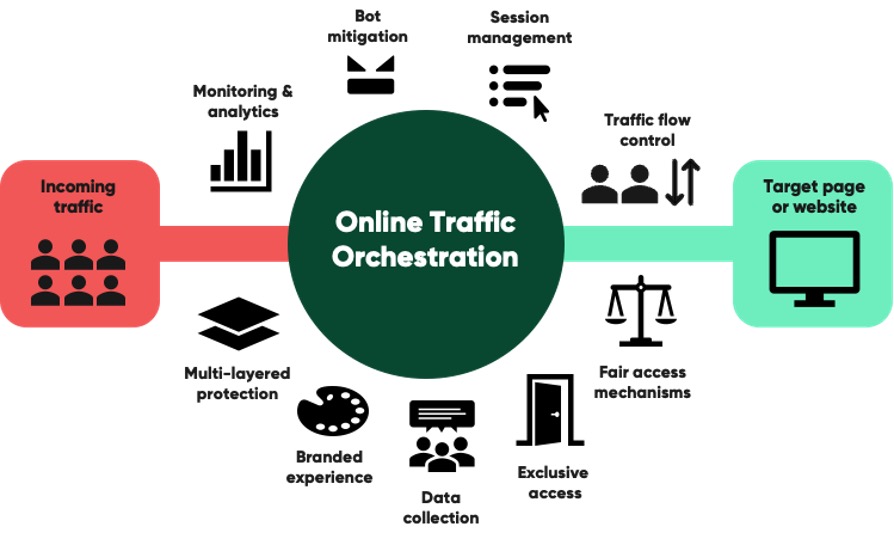
Beyond access and experience control, an orchestration platform gives you visibility into what's actually happening: traffic volume, composition, and behavior in real time. So you can spot and act on bot surges or degraded experiences before they become customer problems.
In a recent Queue-it customer survey, 203 respondents described the key outcomes they achieved from taking control of their online traffic:
- 94% say they prevented site performance issues during high traffic
- 85% say their overall site performance has improved
- 38% average reduction in server scaling costs
- 81% say their sales are fairer
- 88% say their customers' online experience has improved
Online traffic orchestration offers flexible control mechanisms that can be configured for different access, capacity, and visitor experience requirements. How organizations configure an online traffic orchestration platform depends entirely on what they need to protect and the outcomes they hope to achieve.
Queue-it's traffic orchestration process involves four key stages, each of which can be tailored for different objectives:
- Evaluate with Integration Rules: Decide how traffic should be orchestrated and which actions or pages need protection, based on signals like URLs, cookies, headers, or user agents.
- Filter with Traffic Access Rules: Apply custom access logic to each visitor, blocking malicious traffic, challenging suspicious activity, validating visitor journeys, and allowing staff to bypass protection.
- Control with the virtual waiting room: Control the rate at which traffic reaches the target action or page(s) if needed, using configurable waiting room types, fairness logic, stage-based behavior, and a fully customizable visitor experience.
- Manage with session validity rules: Continue controlling behavior after access, freeing up capacity and limiting abuse by enforcing session duration, ending sessions after key actions like purchase, and verifying that each visitor has followed the correct path and is not exceeding allowed actions, such as multiple purchases per session.
These orchestration mechanisms can be configured in various ways to prevent overload, ensure fair access, block bots, reduce scaling costs, increase traffic visibility, deliver exclusive experiences, and more. They're part of one platform that can be used to achieve many goals.
Here are a few examples of how companies across industries typically use online traffic orchestration.
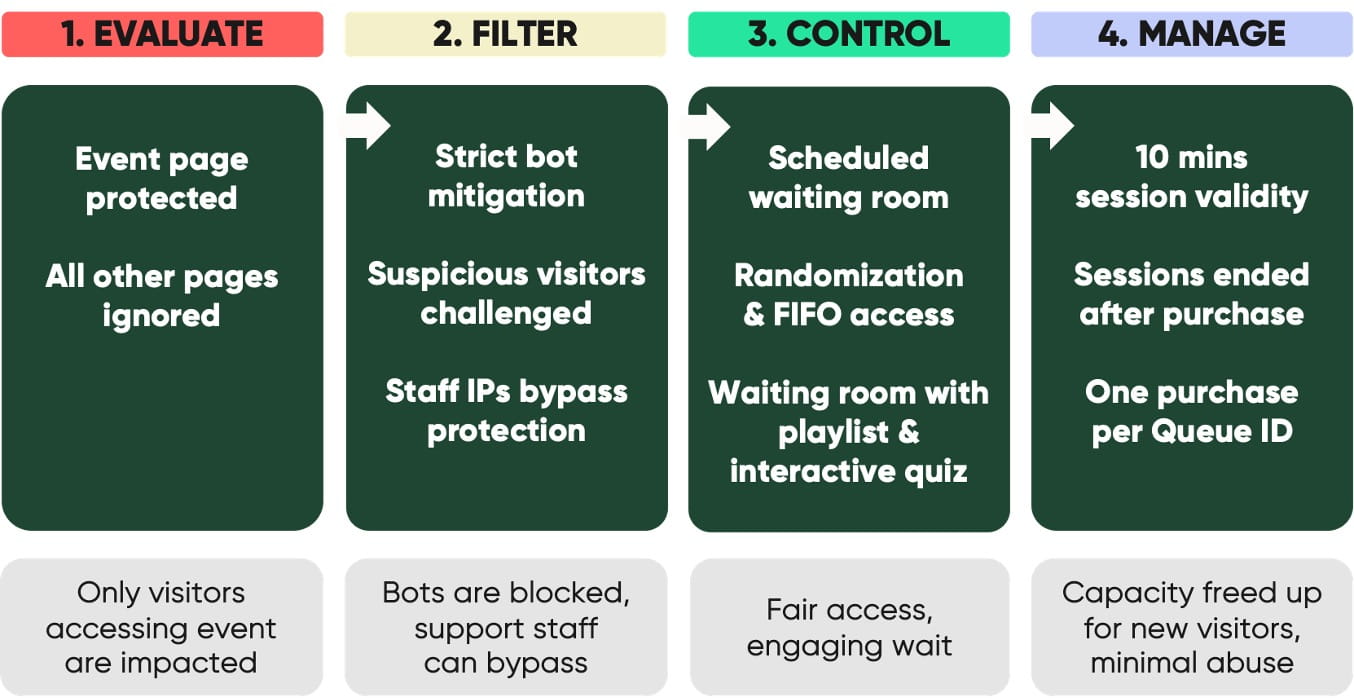
A major onsale puts a ticketing company under pressure from every angle. Tens or hundreds of thousands of visitors arrive within minutes, a huge share of them automated. The site needs to stay up, bots need to be blocked, real fans need a fair shot, and the experience needs to feel managed, not chaotic.
Here's how they'd configure Queue-it’s online traffic orchestration:
- Evaluate: Risk of unfairness and overload applies at the event level, so the company only orchestrates traffic arriving to the event URL, ensuring visitors accessing other parts of the site are unaffected.
- Filter: Strict bot mitigation is applied, blocking malicious traffic and challenging suspicious traffic; staff are given bypass rights for testing and support.
- Control: A Scheduled waiting room is used to collect early visitors and ensure fair, controlled access at the rate the site can handle. The waiting room is customized with an artist playlist and Visitor Engagement quiz about the event, and organizers use Dynamic Messaging to broadcast real-time updates on ticket availability.
- Manage: Strict session validity rules are applied to constantly free up capacity for new visitors and prevent repeat purchases.
“The Queue-it approach of randomizing visitors, then running a first-in, first-out queue is a fairer and more predictable process. … [Queue-it] lets us adjust the traffic outflow on the fly to maximize throughput without compromising reliability, which gives us peace of mind during large onsales.”
Roshan Odhavji, Co-founder and CEO, Megatix

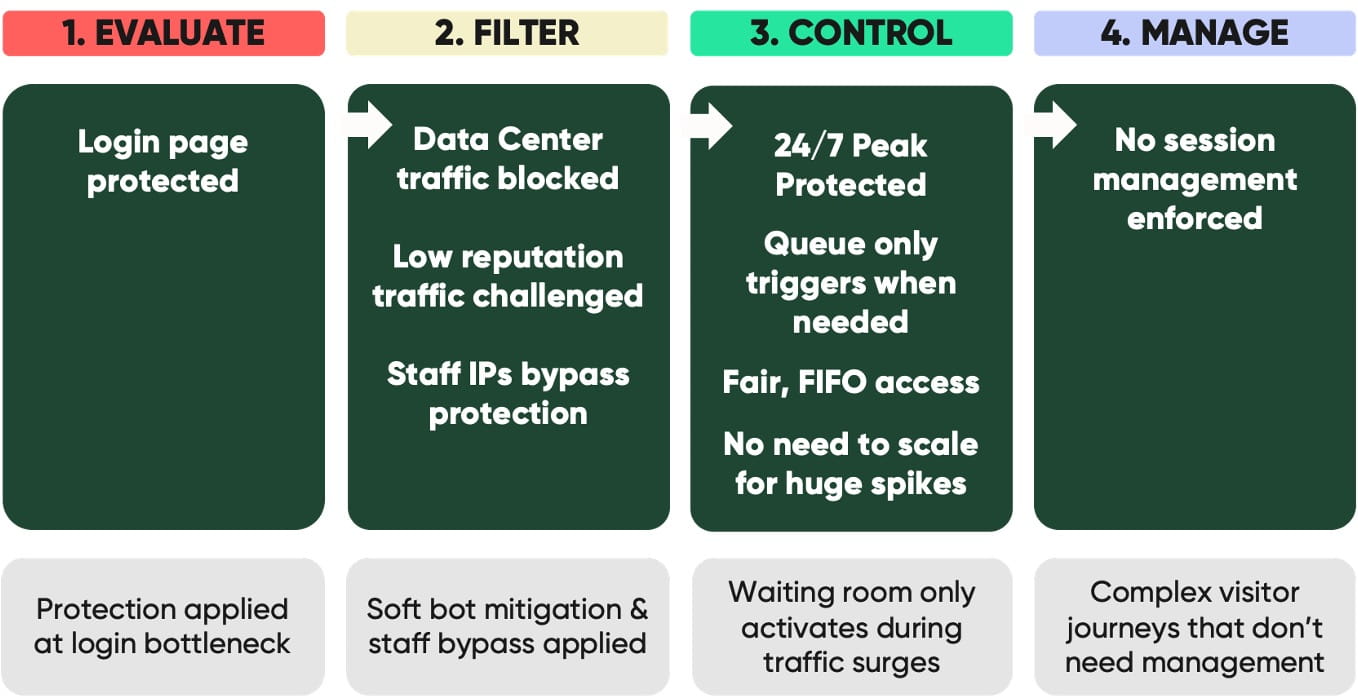
Public sector organizations often face sudden, unpredictable traffic spikes triggered by media coverage, press conferences, or seasonal deadlines. They can't predict when these will happen, and they can't afford to overprovision infrastructure year-round for surges that may last a few minutes.
Here's how they'd configure Queue-it’s online traffic orchestration:
- Evaluate: The organizations key bottleneck when demand surges is their login, so they apply orchestration to all visitors attempting login.
- Filter: Some bot mitigation is applied to clean up traffic and prevent abuse, with data center traffic blocked, low reputation traffic challenged, and staff allowed to bypass.
- Control: A 24/7 Peak Protected waiting room constantly monitors traffic, only triggering a queue if incoming traffic exceeds what login can handle. This prevents sudden spikes from overloading the login bottleneck and minimizes runaway scaling costs. The waiting room answers FAQs and tells visitors which documents they should get ready while they wait.
- Manage: No session management applies—visitor journeys are long and complex and the organization wants to give them all the time they need.
“Paying for super scaled up infrastructure is pointless when we don't need it most of the time. Queue-it offered that extra level of security and the ability to control the traffic spikes. It’s a very cost-effective way of managing demand."
Kevin Lewis, Product Manager, Home Office

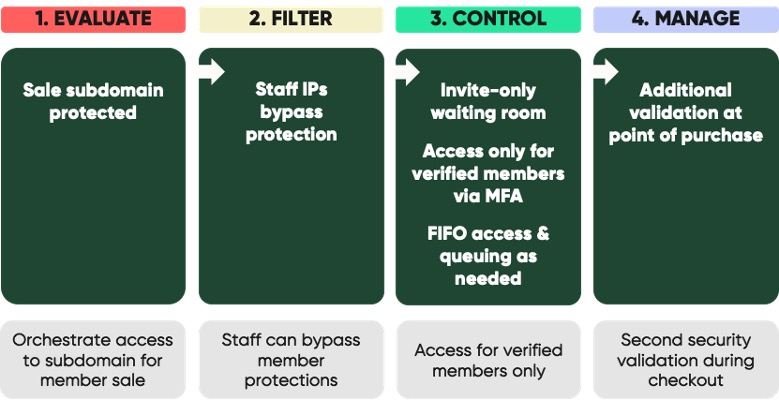
An ecommerce brand running an exclusive early-access sale for loyalty members has a different set of priorities. The goal isn't just handling volume, it's making sure only the right people get in and that the experience feels premium.
Here's how they'd configure Queue-it’s online traffic orchestration:
- Evaluate: Orchestration applies to visitors accessing the exclusive sale subdomain. All other areas of the site are unaffected.
- Filter: No bot mitigation is applied because the following stage will verify identity. Support staff are given bypass rights so they can always access the sale.
- Control: An Invite-only waiting room protects the sale subdomain, prompting all visitors to verify their identity via MFA, and queuing visitors as needed during traffic surges. The waiting room is customized to thanks members and shows a teaser of the deals they'll get access to.
- Manage: At checkout, visitors are automatically validated to confirm they are members that have passed through initial verification, to prevent abuse.
“The VIP sale was a great success. The site stayed online, we hit our targets. And with invite-only, we delivered on the exclusive access we’d promised our VIPs. With Queue-it in place, we're confident we can not only handle the extra demand, but also capitalize on the traffic with exclusive access."
Marcus Forsberg, Head of Ecommerce and Performance, Bedre Naetter

Online traffic orchestration doesn't replace existing infrastructure. It complements it, adding a layer of visitor-level control and business logic that related technologies weren't designed to provide.
Content delivery, scaling, and performance tools are designed to move traffic efficiently and keep infrastructure responsive under load. They're great at making sure your systems can handle requests. But they don't determine who should get through, in what order, or why.
Security and filtering tools can identify threats, accelerate delivery, or rate-limit requests. But they aren’t designed to manage visitor access as a coordinated business process: prioritizing verified visitors, enforcing fair orderly access, matching inflow to application capacity, communicating transparently during a wait, and adapting the experience to the visitor journey.
Online traffic orchestration works alongside both. It takes signals from your security tools, respects the limits of your infrastructure, and adds what neither layer provides on its own: real-time, rule-based control over who gets access, when, and under what conditions.
Most of the tools in your stack are designed to answer the question: "how can we handle this traffic?". Online traffic orchestration answers a different one: "should we let this traffic through, at what rate, and in what way?"
That distinction matters more now than it used to. Traffic is getting harder to read. Bots and AI agents make up a growing share of visitors, and they don't behave like humans. Peaks are sharper and less predictable. And the cost of treating every request the same, whether it's a loyal customer or a scraper, keeps going up.
Organizations that have an orchestration layer in place can see what's happening, set rules for how to respond, and adapt in real time. Those that don't are relying on infrastructure and security tools to make decisions they weren’t designed to make.
The missing piece for most organizations is the ability to control access with fairness, visibility, and business context built in. Online traffic orchestration is that layer. It applies custom access logic at the edge, in real time, ensuring fair and reliable experiences for every visitor. That's how leading organizations stay in control. That’s how online trust is powered for every visitor, every request, and every moment that matters.