
How LivePocket halved database costs during ticket-sale surges

LivePocket's self-service ticketing platform experienced rapid growth following the pandemic, bringing a new challenge: managing unpredictable traffic surges from high-demand ticket releases. Instead of continuously expanding infrastructure, the company turned to Queue-it to protect system stability, maintain fairness, and optimize costs. We spoke with Ryosuke Igarashi, Leader of the System Development Group at LivePocket, about the challenges that led to implementation, their unique approach to traffic management, and the results achieved.
50%
lower database costs
after Queue-it implementation
1,000+
visitors per onsale
queued & released without downtime
LivePocket is a mobile-first e-ticketing platform that enables anyone, from individuals to large organizations, to start selling tickets quickly and easily. Since its launch about a decade ago, the platform has grown by offering a simpler alternative to traditional ticketing services.
Unlike conventional ticket agencies that often require organizer registration and review by the service provider before sales can begin, LivePocket allows users to register and start selling immediately. The pricing is equally straightforward, with a standard 5% fee for paid tickets and no fees for organizers or attendees when distributing free tickets.
The platform is particularly popular within the entertainment sector, supporting everything from idol concerts to entry reservations for character-themed pop-up stores and collaboration cafés.
Many employees at LivePocket are passionate entertainment fans themselves, Igarashi says.
"Some people love rock music, while others are passionate about anime or gaming. Supporting the entertainment industry through LivePocket allows us to support the things we love, and that's something we feel every day."
As events resumed after the pandemic, organizers increasingly turned to the platform because of its ease of use and transparent pricing.
However, the very flexibility that attracted organizers also created operational challenges.
"From an organizer's perspective, it's extremely convenient. From a system perspective, it's difficult to predict which event will become popular, when traffic will spike, and which pages will be affected."
Particularly challenging were first-come, first-served admissions for popular characters’ pop-up shops. In one instance, demand for a highly anticipated character brand release far exceeded expectations, causing severe congestion that required extensive maintenance and recovery efforts.
"Ticket sales typically peak between 10 and 11 p.m. Unfortunately, that's exactly when our system went down. The impact was significant, not only for us but also for organizers who lost valuable sales opportunities."
For LivePocket, simply adding more servers wasn't a sustainable solution.
“Ticket inventory must be managed with absolute accuracy. Many ticket types also require sequential numbering based on purchase order, making database operations particularly resource intensive. Increasing infrastructure alone would not eliminate the bottlenecks, while costs would continue to rise.”
Instead, the company concluded that controlling incoming traffic would be more effective than continuously increasing processing capacity. After evaluating several options, LivePocket selected Queue-it's virtual waiting room. Three factors influenced their decision:
- LivePocket could automate waiting room activation by integrating Queue-it's API with its own monitoring systems.
- The team could also integrate Queue-it at the CDN layer, requiring minimal changes to their existing set up.
- Because the waiting room concept was already familiar with across the ticketing industry, LivePocket knew its customers wouldn't be caught off guard.
"Instead of blocking access, Queue-it enables visitors to queue fairly. That allows us to protect the system while preserving both fairness and ticket sales opportunities."
The team found implementation straightforward, requiring only configuration changes and integration with monitoring alerts. The team also appreciated Queue-it's responsive support model.
Although Queue-it provided the foundation for traffic control, LivePocket faced a unique challenge. As a self-service platform serving approximately 70,000 organizers, the company often ca't predict which events will suddenly attract extraordinary demand. Multiple traffic spikes can also occur simultaneously across different pages.
To address this, LivePocket built a unique operational model. Instead of assigning waiting rooms only to specific events, the company keeps multiple waiting rooms available at all times and automatically activates them through integrations with internal monitoring systems.
"If traffic increases on one page, a waiting room is activated there. If another page experiences a surge, a different waiting room is deployed automatically."
For events with known demand patterns, LivePocket also proactively configures waiting rooms before sales begin, combining automation with advance planning.
“For organizers that have experienced major traffic surges in the past, or for ticket onsales where we expect high demand from the outset, we set up the waiting room in advance. Automatic triggering is effective for unexpected traffic peaks, but when we know the system will come under heavy load, preparing ahead of time is the most reliable approach.”
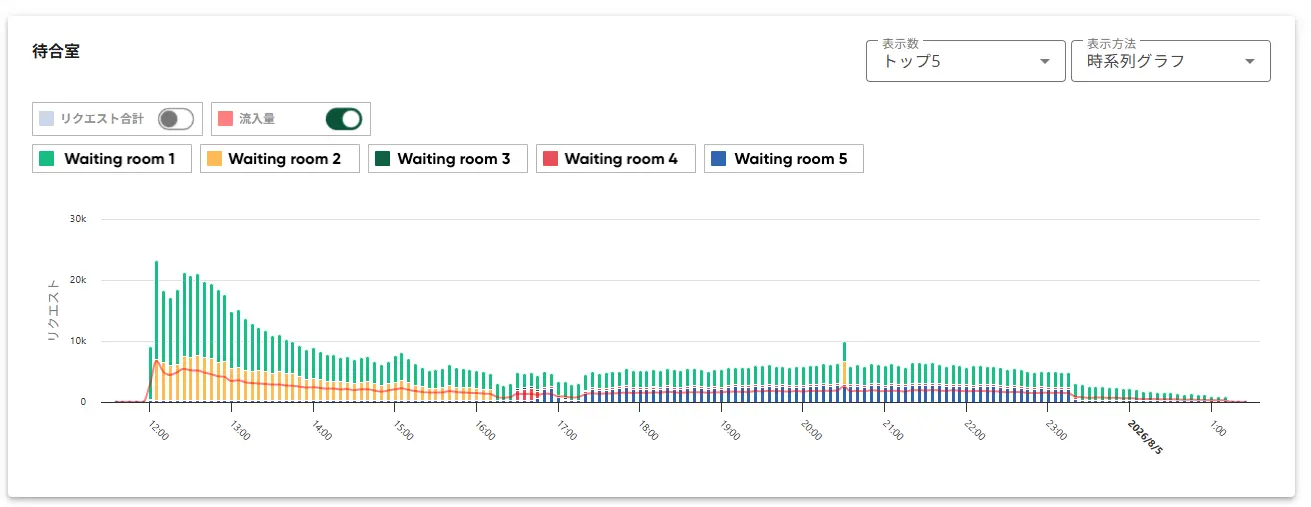
LivePocket traffic data showing five waiting rooms protecting five sites during traffic peaks over several hours.
LivePocket say the impact right away.
“When traffic thresholds triggered system alerts, visitors were automatically directed into the waiting room. As a result, system load that had previously reached 80-90% dropped significantly, demonstrating the effectiveness of controlled traffic flow.“
“More than 1,000 visitors could queue within the waiting room while being gradually admitted to the ticket sales page based on predefined throughput limits. The Queue-it dashboard provided real-time visibility into queue activity, giving the team confidence that sales could continue safely even during heavy demand.”
Beyond improved stability, LivePocket saw substantial cost savings.
“Because we can control the sharp traffic peaks that occur immediately after ticket sales start, we no longer need to provision infrastructure for worst-case demand. Thanks to this, we were able to reduce database-related costs by approximately 50%.”
RYOSUKE IGARASHI, System Development Group at LivePocket

Fans responded positively to the waiting room experience, too.
"We haven’t received any complaints and hardly saw comments from users who were surprised by the waiting room. More and more services are using waiting rooms these days, so customers naturally understand the experience."

LivePocket’s custom theme
Igarashi and his team also value the flexibility to respond to changing system conditions in real time. By monitoring system load through the dashboard and adjusting the waiting room’s outflow in real time, the team can manage traffic with greater precision based on actual demand.
“Being able to adjust the outflow while monitoring the state of our system gives us the confidence that we’re in control of our operations.”
When asked what advice he would give to other businesses facing similar challenges, Igarashi said:
“Queue-it is already widely used across the industry, and the concept is easy for visitors to understand. If you’re considering how to manage traffic surges or reduce system load, it should be one of the first solutions you consider. The barriers to implementation are low, and once you understand how it works, it’s easy to see how it could fit into your operations.”
“In the past, purchasing tickets could take an entire day. Now, fans complete their purchases in the morning, which has significantly improved satisfaction. We’ve even seen cases where customers decide to purchase additional tickets because the process is so much smoother."
RYOSUKE IGARASHI, System Development Group at LivePocket
Igarashi says LivePocket plans to expand how it uses Queue-it. An immediate priority is improving the experience for visitors when tickets sell out while they are still in the waiting room.
The team is exploring two ways to get there: notifying waiting visitors with a message as soon as an event sells out, and building automatic sell-out detection that speeds up the outflow rate so visitors move through the queue faster instead of waiting tto find out.
“It’s better for visitors to find out in the waiting room that tickets have sold out than to wait 30 minutes, reach the sales page, and only discover it then. As a first step, we want to make greater use of the features already available to us.”
The team also wants to explore how the waiting room can become a more useful touchpoint.
“We’d like to customize the waiting room further. While visitors are waiting, we want to be able to share useful information with them, even if it isn’t advertising as such. We’re not there yet, but we’d like to learn from how other companies are using the waiting room and continue improving the experience.”
Today, LivePocket primarily supports events with audiences of around 1,000 to 2,000 people. Looking ahead, it aims to support events attracting several thousand, and venues of 10,000-plus.
But growth does not mean leaving smaller organizers behind.
“That doesn’t mean we’ll stop supporting smaller events. We want to remain a platform that can serve every kind of event, from small gatherings to large-scale venues. And with Queue-it’s continued support, we hope to keep improving our service.”