
How Carp Baseball Club processed 20x more hourly sales with Queue-it

A “citizen-owned team” with a fiercely loyal fanbase, Hiroshima Toyo Carp’s greatest asset has always been its connection with its fans. But popularity brings pressure. On game ticket release days, massive traffic spikes overwhelmed the ticketing site—an issue that persisted for years. Here’s how Carp and their system partner TSS Software turned to Queue-it to protect the fan experience and transform operational efficiency.
20x
hourly sales increase
compared to previous years
100%
uptime
during 2024 ticket onsale
Hiroshima Toyo Carp (Carp)—widely known in Japanese professional baseball as a “citizen-owned team”—was born from the post-war city’s shared dream to build a professional club. That origin story forged an unbreakable bond with fans and the wider community.
Shogo Nishimura, Team Leader in the Ticketing Department, puts it best:
“Because the team was born out of the city’s recovery from devastation, the passion that people in Hiroshima feel for the Carp is incredibly strong. There’s a joke that people always talk about the weather first and then the Carp. The team is truly embedded in everyday life.”
That passion extends well beyond Hiroshima. Relocated fans, multigenerational supporters, and a popularity surge in 2016 built a nationwide following. When ticket sales moved entirely online during the pandemic, that loyalty turned into unprecedented traffic spikes during sales events.
We spoke with Nishimura and Masaki Nakagawa from TSS Software, Carp’s system integrator, about the challenges they faced and how Queue-it helped solve them.
Each year on the first of March, the Carp release tickets for all 72 games of the upcoming season in a single on-sale event. As the club’s popularity grew and sales moved online, these onsales became synonymous with overwhelming traffic surges.
“We were seeing up to 60,000 hits per minute, which far exceeded our system’s capacity,” says Nakagawa. “We tried everything from upgrading memory and infrastructure to adjusting the sales schedule. But nothing moved the needle.”
The result was the system failure and unresponsive pages, which prevented people from access the purchase stage. But the damage went deeper than downtime.
“It was painful to see fans unable to buy tickets,” says Nishimura. “We were flooded with support requests, and frustration spread on social media. Some people even said that buying Carp tickets was a ‘full-day job’—one that starts in the morning and isn't complete until the end of the day.”
Meanwhile, Carp and TSS Software found themselves increasingly occupied with managing complaints rather than focusing on enhancing the fan experience.
Before Queue-it, the team threw everything they had at the problem.
“We tried it all: scaling server capacity, restarting systems as needed, resetting connections, and manually throttling traffic at each step of the purchase flow so users who made it through could actually complete their transactions," says Nakagawa. "But finding the optimal settings was close to impossible. We were constantly operating through trial and error."
"But none of it delivered a lasting fix," Nakagawa continues. "Traffic on sales days kept exceeding capacity. Stable operations felt out of reach.”
The Carp and TSS Software knew they needed a fundamentally different approach. That search led them to Queue-it.
“Queue-it’s track record at major sporting events and its adoption by other professional baseball teams gave us the confidence it was something we could rely on,” says Nishimura. “At the time, scaling infrastructure seemed like the only option, but we knew there were limits to that approach. Queue-it stood out as a practical, realistic alternative.”
And for Nishimura, the level of support sealed the deal: “It was our first time implementing a solution like this, and the Queue-it team provided excellent support. We were impressed by their confidence in the system, which gave us the assurance we needed to move forward.”
On March 1, 2024, the Carp held their first ticket onsale using Queue-it. The difference was immediate.
“Before, even if sales started at 8 a.m., errors would drag on for hours, and actual purchase requests wouldn’t come through until around 3 p.m. With Queue-it, requests started flowing smoothly right from the beginning," explains Nishimura.
What was once an all-day ordeal became a system where sales no longer stalled.
“With Queue-it, we increased the number of sales processed per hour by nearly 20x year-over-year. The control over traffic made a huge difference to our sales and customer experience.”
MASAKI NAKAGAWA, MANAGER at TSS SOFTWARE

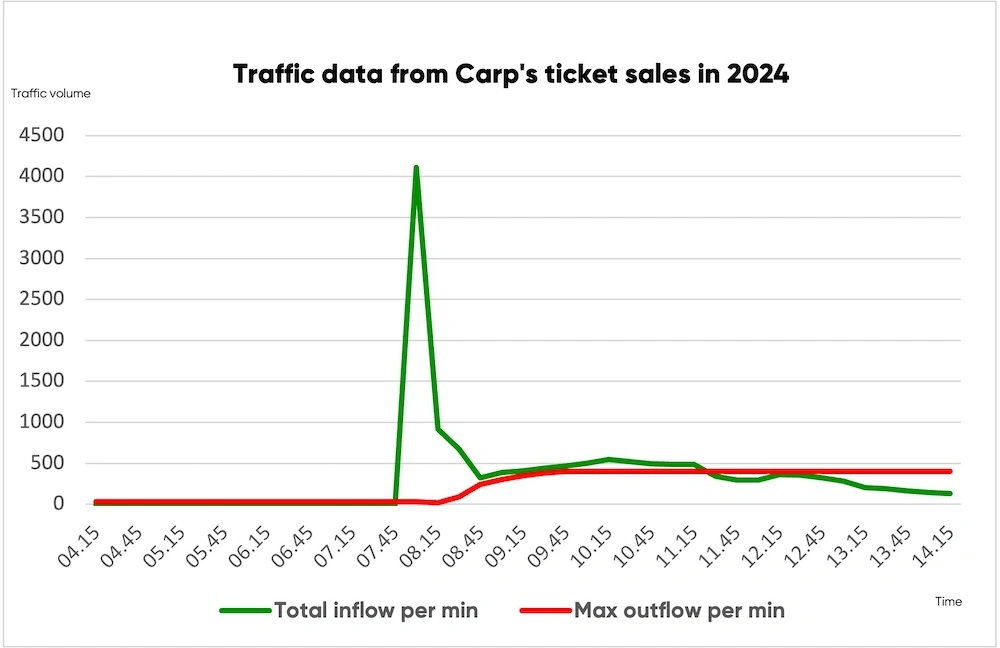
Traffic data from Carp's ticket sales after implementing Queue-it
But the impact went beyond raw throughput. Queue visibility gave fans something they never had: transparency. Instead of refreshing the page repeatedly, they could see exactly where they stood and how long the wait would be. Frustration gave way to confidence.
“In the past, purchasing tickets could take an entire day. Now, fans complete their purchases in the morning, which has significantly improved satisfaction. We’ve even seen cases where customers decide to purchase additional tickets because the process is so much smoother."
Shogo Nishimura, Team LeadeR at Carp
"Queue-it’s email notification feature added another layer of convenience. Fans can step away from their screens entirely and return when it's their turn", he continues. "It allows people to use their time effectively while they wait."
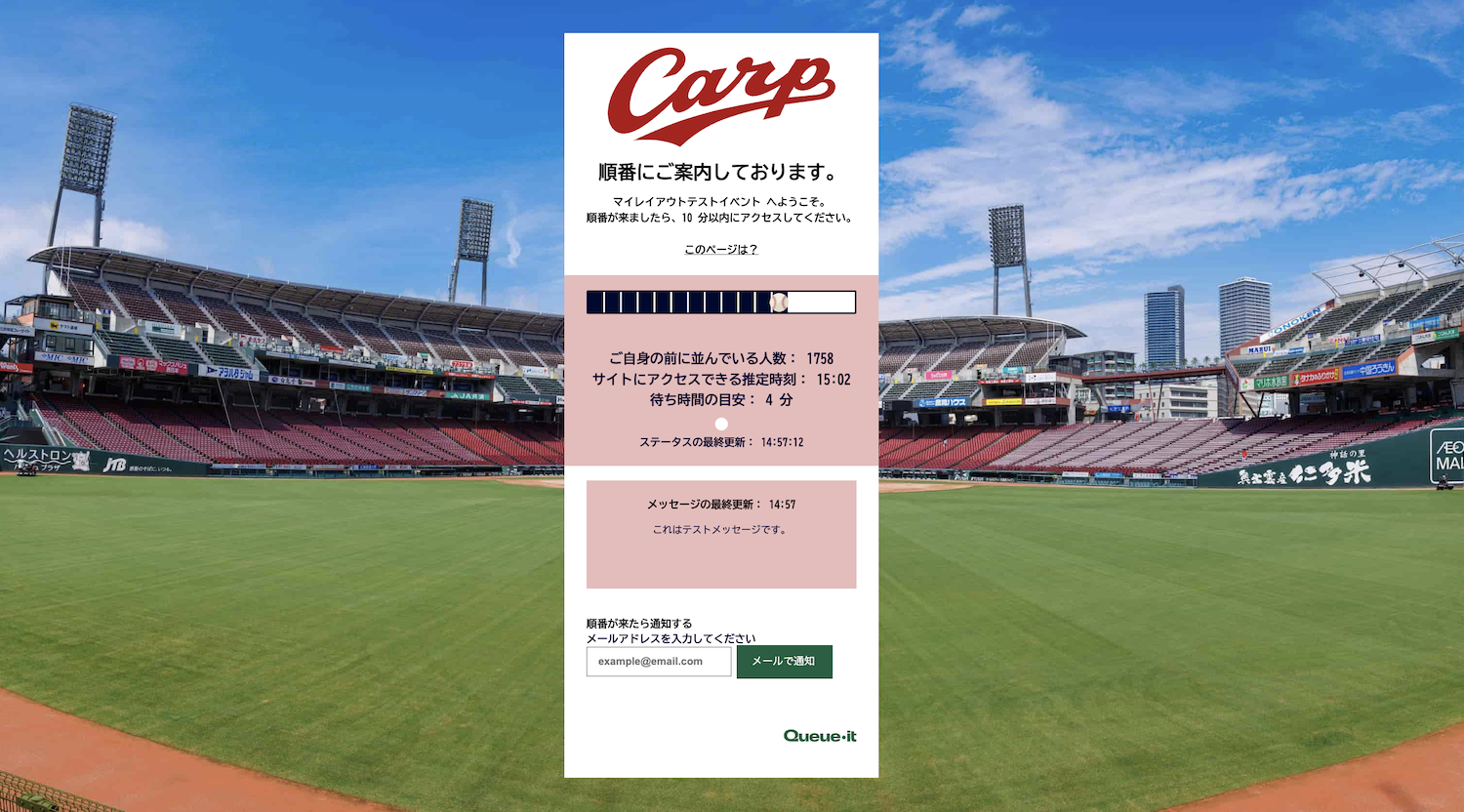
Carp’s Custom Theme Queue Page
The transformation ran just as deep on the operational side.
“We hardly need to perform manual tuning anymore, and we can go into each sales event with confidence. With Queue-it’s support, we applied what we learned in the first year to further improve operations in the second. By 2025, the hourly request volume had doubled again," says Nakagawa.
But for Nakagawa, the most meaningful change wasn’t a metric. It was emotional.
“In the past, seeing error screens shared on social media was tough", he explains. "Now that those issues are gone, there’s a real sense of relief. The improvements are both quantitative and qualitative.”
Fairness improved too. With traffic control and session management in place, access is more effectively distributed to genuine users.
“We’ve seen a clear improvement in the quality of our traffic—reducing bot traffic and cutting down repeat purchases. With Queue-it, it feels like we're actually putting tickets in the hands of genuine fans, not scalpers and bots," states Nakagawa.
With international tourism on the rise, Nishimura sees an even bigger stage ahead.
“With more international visitors coming to Japan, we feel that Hiroshima is also gaining global attention. We want visitors to experience Carp games and Japanese professional baseball," Nishimura explains.
"And as we expand our content and events to engage more fans, we expect there will be more opportunities to use Queue-it—not just for ticket sales, but in other high-demand scenarios as well," he adds.
For the Carp, implementing Queue-it was never just about simply managing traffic. It’s about a promise to fans: that when demand spikes, the experience holds. Fair access, smooth purchasing, and trust—on every sales day, for every fan.