
What’s new in Connectors: Queue-it Connectors overview 2026

Direct Pass, BYO CDN, Double Queue Exemption, and advanced session protection. Queue-it's latest Connector releases introduce some of the most significant improvements we've made to reliability, security, and traffic control in years. Here's what's new, and what upgrading unlocks.
Queue-it Connectors are the integration layer between your infrastructure and Queue-it's online traffic orchestration platform. They're responsible for evaluating incoming traffic, determining how to handle visitors, and validating sessions once they’re on your website.
Over the past year, Queue-it has shipped meaningful updates across our 20+ connectors, covering security, reliability, and operational flexibility—from BYO CDN, to Direct Pass, to Double Queue Exemption.
This blog gives a full overview of what's available across Queue-it’s Connector versions, walks through the most important new capabilities, and helps you figure out whether it's time to upgrade.
Table of contents
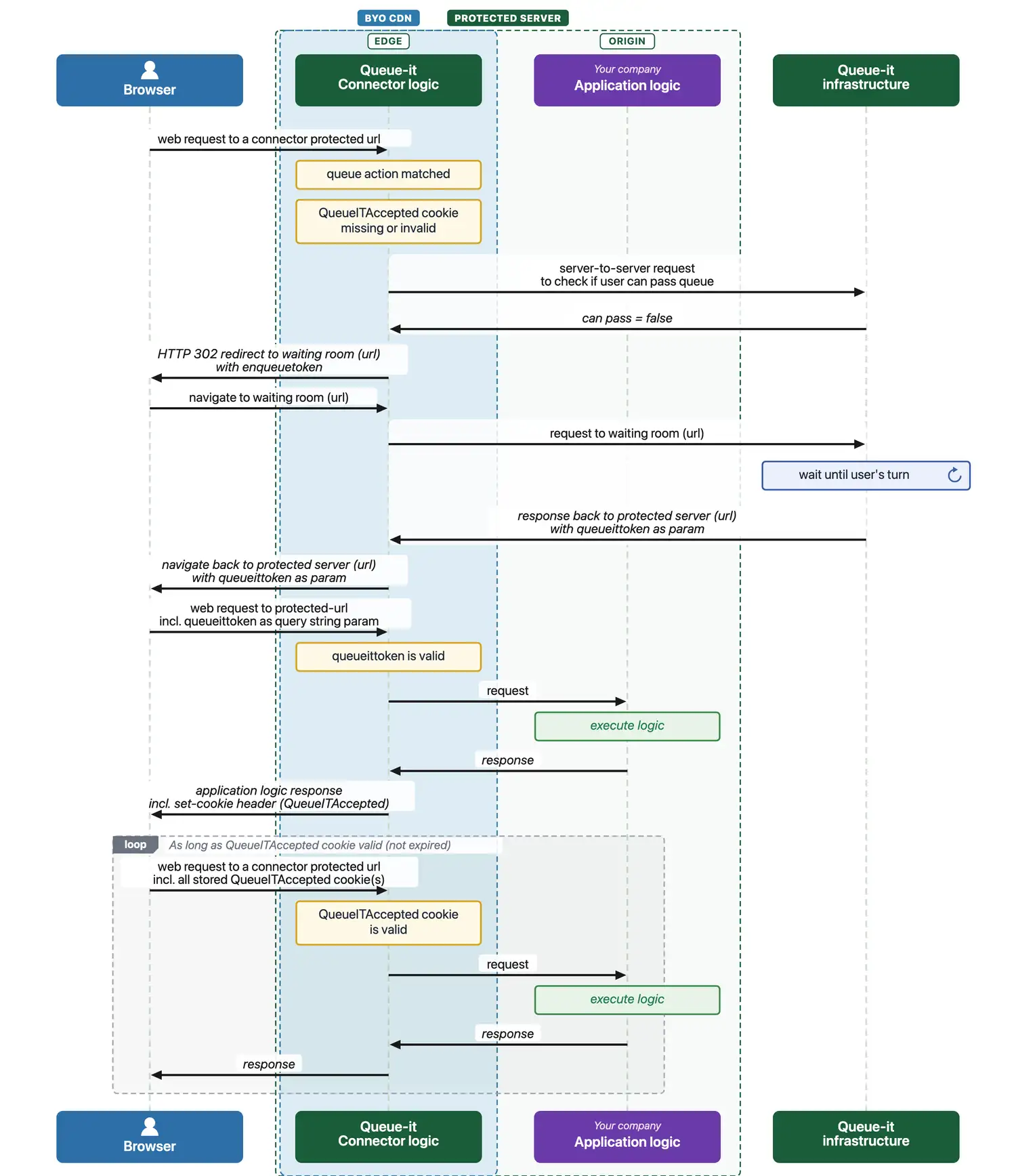
Bring Your Own CDN (BYO CDN) changes how Queue-it is deployed in your architecture. Instead of the browser connecting directly to Queue-it during the waiting room flow, your CDN sits in front—forwarding traffic to Queue-it and returning the response on its behalf.
In practice, Queue-it runs behind your CDN, rather than as a separate, externally visible system.
This has a practical impact. You keep traffic inside your existing edge layer, where your team already applies bot mitigation, WAF rules, and traffic controls. Queue-it becomes part of that flow, rather than operating alongside it.
The BYO CDN integration for Queue-it unlocks a few powerful benefits:
- Deeper security integration: Combine Queue-it with your CDN’s bot mitigation and WAF logic
- Same-domain experience: Keep visitors on your domain throughout the queuing flow
- Full control over data flow: Manage headers, cookies, and what gets passed to Queue-it
- Simpler operations: Handle certificates and routing within your existing CDN setup
- Better performance and consistency: Keep traffic within your optimized edge network
In simple terms, rather than exposing Queue-it directly in the user journey, BYO CDN routes the entire experience through your own edge infrastructure from start to finish.
Note that BYO CDN requires White Label add-on, and is currently available only for Akamai, CloudFront, Cloudflare, and Fastly. To learn more and implement BYO CDN, contact Queue-it support or visit our Help Center (you'll need your Queue-it log in for access).
Direct Pass improves how Queue-it handles non-peak traffic (traffic that doesn't need to be sent to the waiting room) by eliminating the need for a 302 redirect in non-peak conditions.
Instead of redirecting every first-time request through Queue-it, the Connector evaluates whether a queue is active and only redirects when required. Queue-it is still used to determine whether traffic control is needed, but is no longer part of the visitor redirect path unless a queue is active.
How Direct Pass works
For a request to a protected resource:
- The request reaches your edge or origin
- The Queue-it Connector checks:
- Whether the path is protected
- Whether the request includes a valid queue token
- If the request requires validation (protected path without a valid token), the connector makes a call to Queue-it to determine if a queue is active
- Based on that response:
- No active queue → the request is allowed to proceed directly to origin (no redirect)
- Active queue → the request is redirected (HTTP 302) to the waiting room
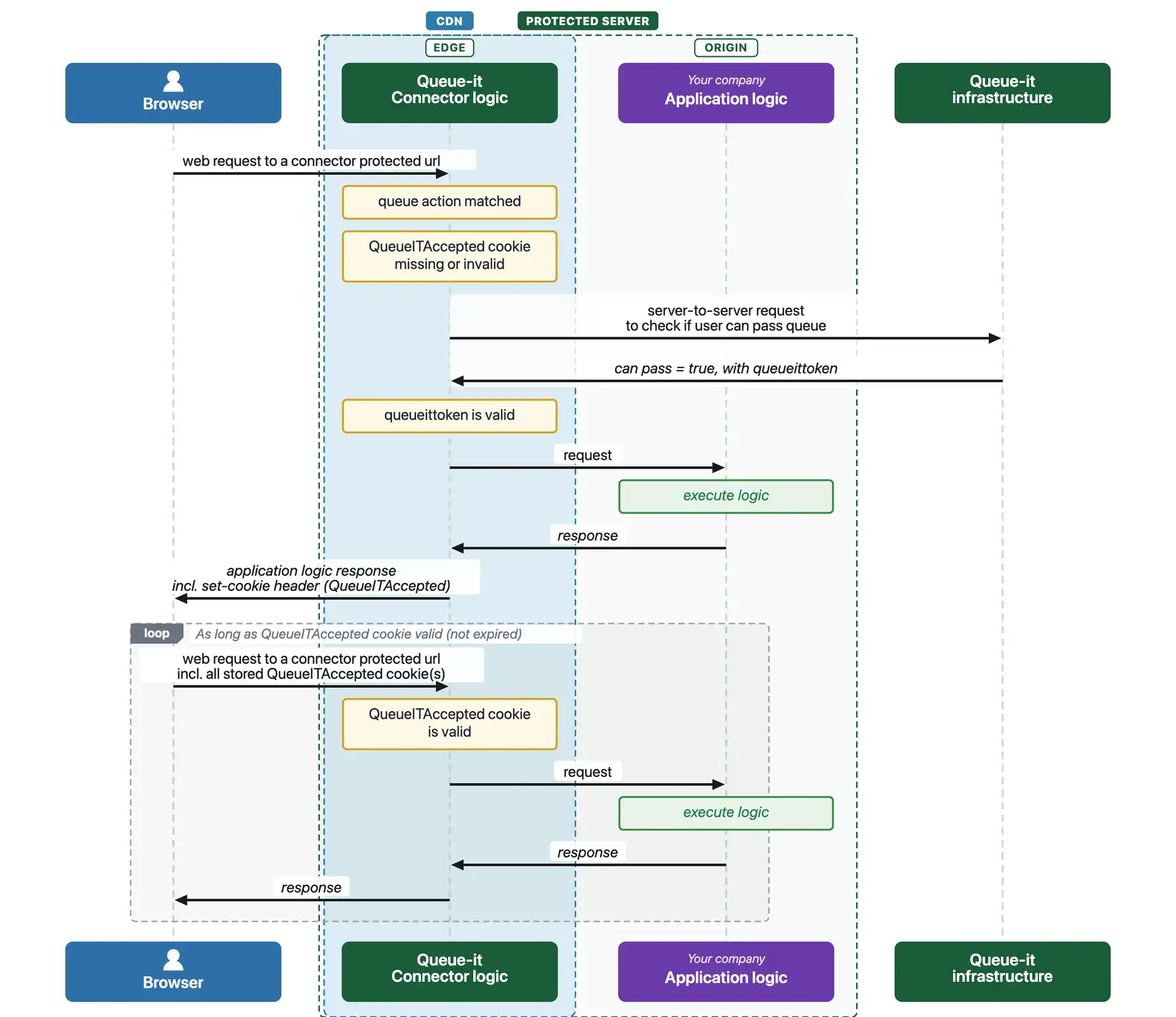
The key difference is that the redirect is now conditional, rather than part of the default flow.
Direct Pass has several key benefits for Queue-it customers:
- No redirect for non-peak traffic: Requests follow the normal path when no queue is active, without unnecessary round trips
- Reduced dependency outside peak events: Queue-it is consulted for queue state but is not part of the redirect path for every request
- Fail-open behavior on connectivity issues: If Queue-it cannot be reached, requests are allowed to proceed, avoiding disruption to normal traffic
- Same enforcement when a queue is active: Queuing behavior remains unchanged when protection is required
- Reduced latency for non-queued users: Users reach your origin faster by avoiding redirect flows
Direct Pass is available from Connectors v5 and up, which at the time of writing includes Akamai, CloudFront, Cloudflare, Fastly, and Tencent.
To learn more and upgrade to a v5 Connector, contact Queue-it support or visit our Help Center (you'll need your Queue-it log in for access).
Double Queue Exemption makes it easier to configure and manage multiple waiting rooms running simultaneously on the same domain.
This update is particularly useful for customers hosting Invite-only or a special landing page waiting rooms alongside general-access waiting rooms; or those running several simultaneous sales, such as concert tickets or product drops.
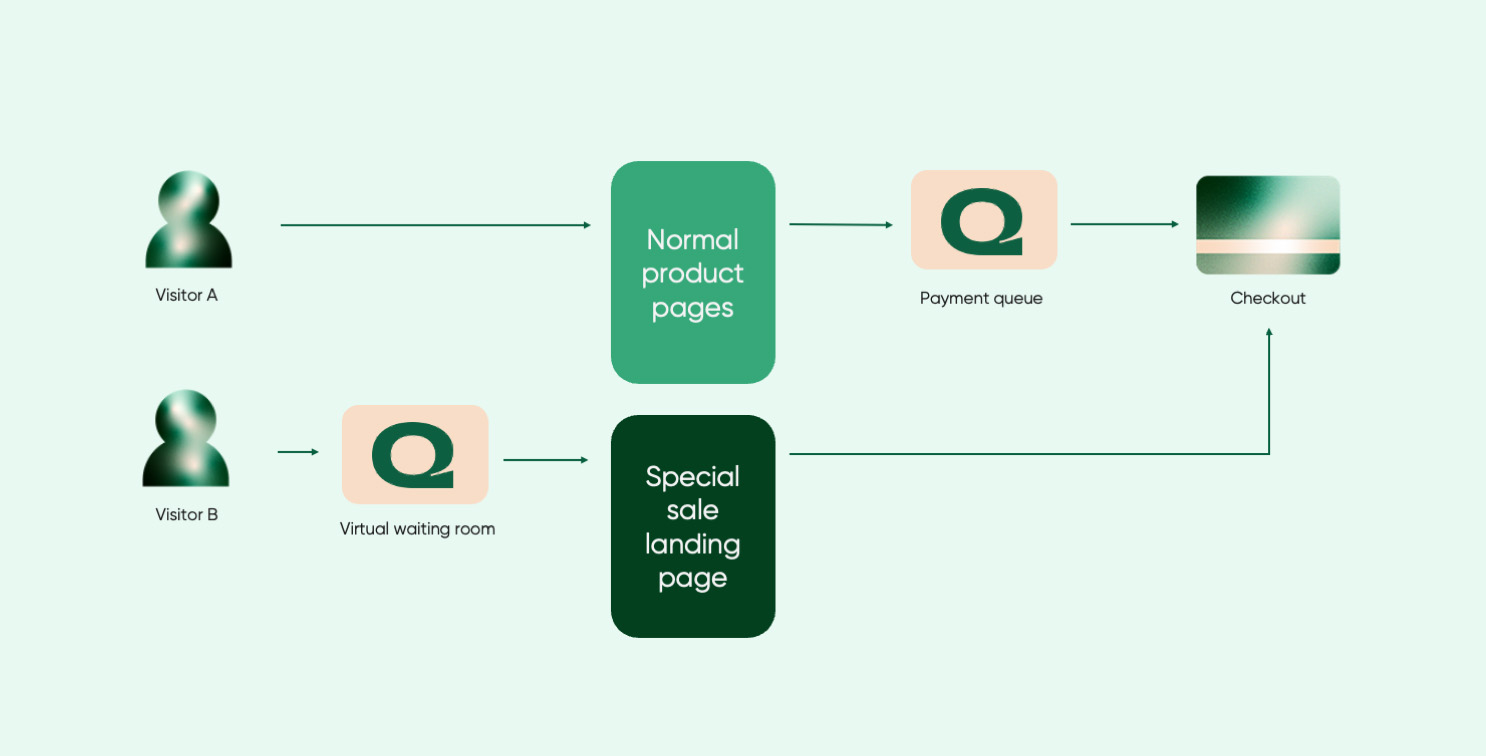
The diagram above depicts a fairly typical integration setup for a Queue-it customer running two waiting rooms concurrently. They have one waiting room protecting their payment gateway, which applies to all visitors checking out. Then they have a second waiting room protecting a specific product URL or sale subdomain.
Previously, a visitor who has queued at the landing page level could potentially need to queue again before the payment gateway.
This poor user experience can be avoided with Double Queue Exemption. Once visitor B passes through the first waiting room, they become exempt from the second.
Double Queue Exemption helps you manage complex journeys and multiple concurrently running waiting rooms efficiently and fairly, especially during sitewide peak traffic. It can be configured via Queue Actions and Cancel Actions in Integration Rules.
New iOS SwiftUI Native App Connector: A new iOS Connector built for SwiftUI, Apple’s most modern and recommended UI framework. The GitHub repo is available here.
New Huawei HarmonyOS Native App Connector: A new HarmonyOS Connector for Huawei devices, strengthening Queue-it's support and flexibility for customers across the Asia-Pacific region. The GitHub repo is available here.
The table below shows which features are available in each Queue-it Connector generation (v3, v4, and v5). If you're running an older Connector, this is the quickest way to see what you're missing and what an upgrade would unlock.
To see an up-to-date list of which Connector versions Queue-it currently supports, view our Connector Support Framework here.
| Connector Feature | Description | Benefits & use cases | v5 | v4 | v3 |
|---|---|---|---|---|---|
| Direct Pass | Allows requests to proceed directly to protected pages without the need for a redirect to Queue-it’s infrastructure. | For customers running 24/7 Peak Protected waiting rooms, Direct Pass removes any dependency on Queue-it, improving reliability and latency. | ✅ | ❌ | ❌ |
| Bring Your Own CDN | Routes all waiting room traffic through the customer's own CDN instead of sending visitors directly to Queue-it. | Enables integration with your CDN's bot tooling (e.g., Akamai Bot Manager), cookie and header control, simplified certificate management, and same-domain visitor experience. | ✅ | ❌ | ❌ |
| Double Queue Exemption | Ensures visitors who have already passed through one waiting room are not redirected to another one on the same journey. | Simplifies complex setups with multiple simultaneous waiting rooms, such as Invite-only waiting rooms alongside general-access rooms, or concurrent sales on the same site. | ✅ | ✅ | ❌ |
| IP Binding (beta) |
Ties a visitor's session to their IP address across all or selected steps of the user journey. In beta, contact Queue-it support for early access. |
Prevents session sharing and cookie hijacking by blocking visitors from using their queue session on a different network or device. | ✅ | ✅ | ❌ |
| Verify Action (beta) | Checks how many times a specific action (e.g., add-to-cart, proceed to payment) has been completed by a visitor with the same Queue ID, and blocks them if the limit is exceeded. In beta for Akamai Connector, contact support for early access. |
Prevents bulk purchasing and other abuse by enforcing per-visitor action limits during the protected journey. | ✅ | ✅ | ❌ |
| Ignore Action | Allows predefined IP addresses to bypass the waiting room entirely. | Lets internal staff, monitoring tools, and known good bots (e.g., uptime checks) access protected pages without queuing. | ✅ | ✅ | ❌ |
| Cancel Action | Invalidates the visitor's session after they perform a specified action. | Enforces one-time access or transaction limits. For example, after a successful checkout, visitors can be required to queue again before making another purchase, freeing up capacity, preventing bulk purchasing, and ensuring fairness. | ✅ | ✅ | ✅ |
| Enqueue Token | A short-lived, cryptographically signed token required to enter the waiting room. Generated automatically by v4+ connectors. | Blocks bots and direct-access attempts by ensuring only visitors who started their journey from the protected site (via the Connector) can enter the waiting room. Visitors without a valid token are denied entry. | ✅ | ✅ | ✅ |
| HTTPOnly or Secure cookie flags | Sets Queue-it session cookies with HTTPOnly and/or Secure flags. | HTTPOnly prevents client-side scripts from reading the cookie, reducing XSS risk. The Secure flag ensures cookies are only transmitted over HTTPS, preventing interception over insecure connections. | ✅ | ✅ | ✅ |
| Request Body Trigger | An Integration Rule condition type that evaluates the content of POST request payloads. Not available for: Akamai, Salesforce, Fastly, Lua, Magento. |
Enables granular, product-level protection. For example, protect adding one specific product to the cart but not another, even when both share the same URL. | ✅ | ✅ | ✅ |
| Integration Rules | A rule-based framework for configuring which pages are protected and how the connector handles matching requests (Queue, Ignore, Cancel). | Centralizes waiting room configuration in the GO Queue-it Platform and through API. Rules can be updated and published without code changes, supporting flexible, on-the-fly traffic orchestration. | ✅ | ✅ | ✅ |
| Hybrid Queue Client JavaScript | Combines a client-side JavaScript connector with server-side KnownUser protection on the same site. | Lets you use server-side protection for page requests while adding client-side coverage for AJAX/fetch calls, providing broader protection without duplicating waiting rooms. | ✅ | ✅ | ✅ |
| Verification of the Queue-it Token & Queue-it Cookie | Core connector logic that validates the Queue-it Token (returned from the waiting room) and issues/verifies the session cookie granting access to protected pages. | Foundational security layer ensuring only visitors who have legitimately passed through the waiting room can access protected content. | ✅ | ✅ | ✅ |
The biggest improvements in this round of Connector updates focus on resilience and security.
BYO CDN lets you keep traffic within your own edge infrastructure, improving control over routing, security, and performance. Direct Pass improves resilience and speed by removing redirects in non-queue scenarios. And Double Queue Exemption gives you more control over how visitors move between waiting rooms in complex setups.
Together, these changes strengthen how traffic is handled and how consistently protection is enforced—across both peak and non-peak scenarios.
If you're still running older Connector versions, you're missing out on significant improvements in resilience and security.
Access to v4 and v5 Connectors is currently provided on request. To upgrade your Connector, visit the Queue-it Help Center or reach out to your Customer Success Manager. We're happy to walk you through the changes and help you make the most of them.
For the full, up-to-date comparison of Queue-it Connectors, check out our Connector Support table.