


AI shopping helps consumers shop smarter. Agentic ecommerce allows AI agents to shop for them.
It's a subtle distinction with a significant price tag attached. Bain & Company projects that the US agentic commerce market could reach $300 to $500 billion by 2030, or roughly 15 to 25% of total ecommerce sales.
For most retailers, AI in ecommerce has meant better recommendations, smarter search, and conversational AI shopping assistants. But that's only part of the story. A growing number of AI agents can now act on a consumer's behalf, researching products, comparing options, and even completing purchases.
This shift from AI-assisted shopping to agent-driven transactions marked the beginning of agentic ecommerce. While adoption remains in its early stages, the impact will redefine what ecommerce means and is imminent. Retailers need to design experiences not just for human customers, but for autonomous agents interacting with their sites at machine speed – and they need to do it sooner rather than later.
In this article, we'll look at the challenges and opportunities this new era of agentic ecommerce brings, in addition to 5 steps you can take to be ready to take on the Agentic era.
Traditional AI in ecommerce is built to assist, not act. It helps a shopper discover products, get answers, and check out faster, but the human is still the one making the selection along the way. You'll probably recognize the few examples of this below:
- Product recommendations: Personalization engines surface items based on a shopper's browsing history and past purchases, narrowing down the catalog before they even start searching.
- Personalized search: AI-powered search interprets natural-language queries like “something cozy for a rainy weekend trip” instead of requiring exact keyword matches.
- Customer service bots: Conversational AI shopping assistants resolve routine questions about shipping, returns, and order status without waiting on a human agent.
Adoption of these tools is already close to universal. 96% of online retailers now use AI in their ecommerce operations, either fully or experimentally.
The common thread across it all is: the agent recommends, forecasts, or automates, but the customer still needs to make decisions, checkout and pay.

Agentic ecommerce shifts that balance of control. Instead of assisting a human, the AI agent acts on human behalf, executing multi-step tasks toward a goal and, increasingly, with real spending authority. IBM defines it as an approach in which “AI agents act on behalf of consumers or businesses to research, negotiate and complete purchases, often without direct human intervention.”
This can look like:
- AI that acts on behalf of customers: Agents that research, decide, and transact within parameters a shopper sets in advance.
- Autonomous product research: Comparing prices, reviews, and specs across retailers in seconds instead of manually jumping between tabs.
- Purchase execution: Completing checkout without a human clicking “buy,” a capability now live through integrations like Visa’s payment network embedded directly in ChatGPT.
- Replenishment ordering: Automatically re-ordering household essentials based on usage patterns and budget rules.
- Shopping agents: Purpose-built tools, such as Perplexity’s Comet, designed to browse and buy across the web toward a defined goal.
The table below captures where the two models diverge.
| Traditional AI | Agentic commerce |
|---|---|
| Assists humans | Acts for humans |
| Recommendations | Autonomous action |
| Human approval required | Decisions can be delegated |
| Optimized for engagement | Optimized for outcomes |
| Website interactions | Agent-to-agents interactions |
AI-referred traffic is no longer a rounding error in retailers' analytics. Traffic from generative AI sources to US retail sites grew 1,300% between November 1 and December 31, 2024, compared to the year before, and some estimates now put the total increase of agentic traffic at 7,851% across the web.
That volume is translating into real commercial upside. Customers arriving via AI agents are 10% more engaged than traditional visitors, reaching retailers further down the funnel with stronger purchase intent, because the agent has already done the comparison shopping before the visit even happens.
But the number worth building a strategy around is revenue.
Remember that Bain projects the US agentic commerce market at $300 to $500 billion by 2030, while McKinsey puts the global opportunity at $3 to $5 trillion, including up to $1 trillion in orchestrated US retail revenue.
Retailers who build for agentic ecommerce today are positioning themselves to capture a meaningful share of that growth; not just defend against the disruption it brings.
The upside is real, but so is the operational complexity. As agentic traffic scales, retailers face new risks alongside the new revenue.
When an agent completes the transaction on a shopper's behalf, retailers lose visibility into the moments that typically build brand loyalty, the browsing, comparing, and second-guessing that once happened directly on their site. At the same time, AI agents now account for a growing share of total site traffic, with some estimates suggesting over half of all web traffic is already non-human.
That volume brings a tricky problem: telling the difference between a legitimate shopping agent and a malicious scraper, since both can look nearly identical to traditional detection tools and mimic the same browsing behavior.
And when agents can query and transact at machine speed, human shoppers risk being crowded out during flash sales, restocks, or ticket releases. Exactly the kind of imbalance orchestration platforms are built to prevent.
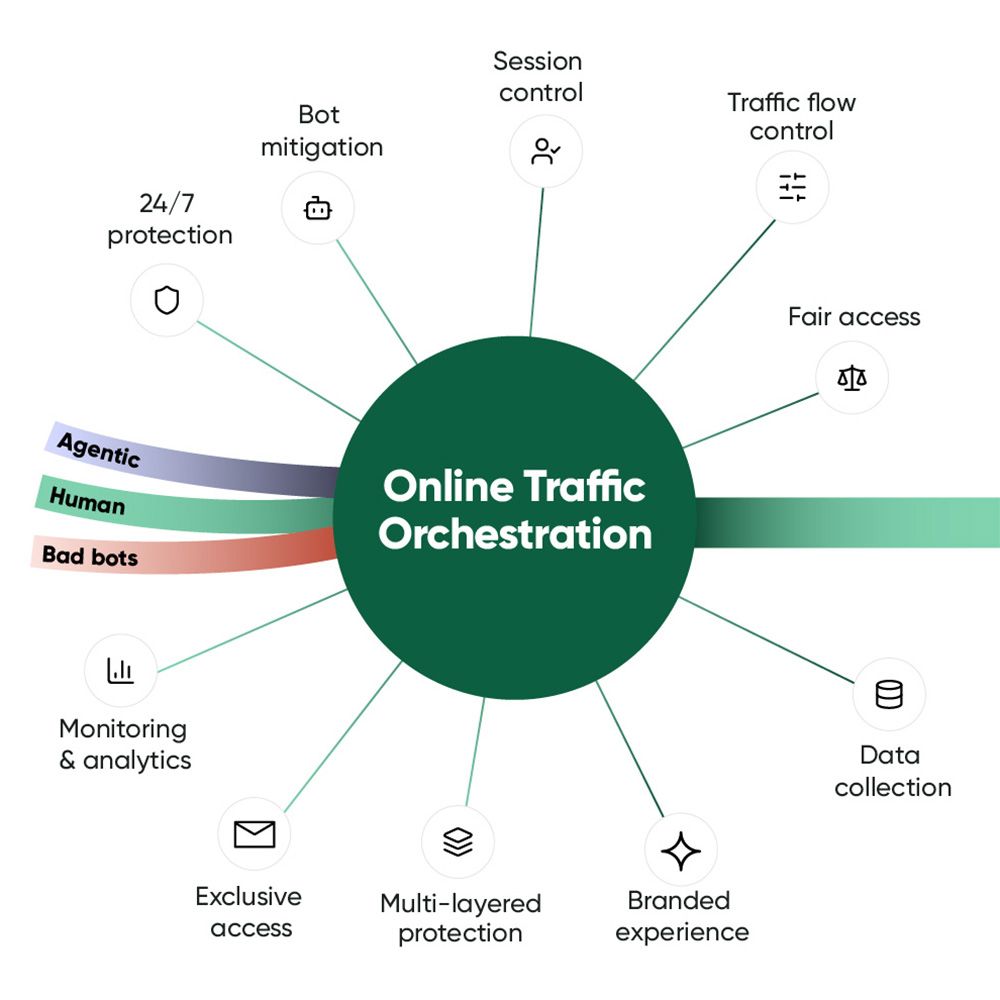
AI agents represent a growing ecommerce buying channel, one that requires both enablement and governance, alongside mechanisms for fair access and orchestration.
This is where Queue-it's online traffic orchestration comes in: helping businesses distinguish every request, from a customer, a bot, or an AI agent, is evaluated on identity, intent, and context, so you decide who gets access, when, and under what conditions.
Ensuring that as agentic commerce scales, access stays fair and experiences stay reliable, without leaving revenue on the table.
This isn't hypothetical. In a joint proof of concept announced in July 2026, Queue-it, Dai Nippon Printing (DNP), and Mecco demonstrated what fair agentic access looks like in practice: a hype-event sale where humans and AI agents compete for the same limited inventory under the same rules.
The shopper authorizes their agent with a verified digital credential and a mandate to act on their behalf. The agent then joins the queue like any human visitor and completes the purchase through to shipping confirmation.
The shopper authorizes their agent with a verified digital credential and a mandate to act on their behalf. The agent then joins the queue like any human visitor and completes the purchase through to shipping confirmation.
The principle behind it is simple: fairness shouldn't depend on whether traffic comes from a human or an AI agent — it should be based on verified intent, trusted authorization, and equal treatment.
"The future internet will not separate humans from agents. It will separate trusted intent from abuse." - Hans Skovgaard, CPTO at Queue-it
Preparing for agentic ecommerce isn't a single project. It's a set of foundational changes to how sites, data, and infrastructure are built, each addressing a specific point where agents and retailers may currently fail to connect.
- Build agent-ready experiences: Ensure sites and APIs are structured so agents can navigate, evaluate, and transact without friction. Many retailers are unintentionally invisible to the agents doing the shopping: audits have found that a majority of ecommerce sites block or fail to explicitly allow at least one major AI crawler, often through a robots.txt file that was last updated for Googlebot and never revisited. If GPTBot, ClaudeBot, or PerplexityBot can't crawl a product page, that product won't show up in an agent's recommendations, no matter how strong the marketing or pricing is.
- Improve your structured data: Standardized product attributes, using schema.org markup, help agents accurately interpret pricing, availability, and specs instead of guessing. This is the difference between a product ecommerce agents can recommend and one they skip entirely: stores with complete schema.org markup appear roughly 3.1 times more often in AI shopping results than those with partial or missing data, and in a production audit of a US Shopify store, AI shopping assistants ignored more than 40 percent of a retailer's inventory simply because the product feed lacked stable identifiers and structured fields.
- Support APIs: Expose pricing, inventory, and checkout through machine-readable APIs rather than relying on agents to scrape web pages. Emerging standards like the Agentic Commerce Protocol, backed by OpenAI and Stripe, and Shopify's Universal Commerce Protocol are quickly becoming the expected way agents complete a purchase. Retailers who expose a proper checkout API get a predictable, controlled transaction; those who don't leave agents to interpret a checkout flow built for a human, which is slower, less reliable, and more prone to errors on both sides.
- Develop governance frameworks: Establish clear policies for data access, spending limits, and accountability as agents gain more autonomy over transactions. This is urgent precisely because most organizations aren't ready: a recent survey of 500 enterprises found that 71% lack a formal governance framework and 64% plan to increase agent autonomy within 12 months, even as most plan to increase agent autonomy within the next year. Without defined spend caps, approval thresholds, and audit trails, a retailer has no way to answer a basic question when something goes wrong: which agent, acting on whose behalf, made this decision?
- Prepare your infrastructure for human and agentic traffic: Build the capacity and controls to manage demand spikes from both audiences without compromising performance or fairness for either. Agent traffic doesn't behave like human traffic: it can query, compare, and attempt checkout in rapid, concentrated bursts, which is exactly the kind of non-linear load that causes database locking, cache stampedes, and checkout failures during peak events. The retailers most exposed here are the ones still planning capacity around human browsing patterns alone.
By 2030, agentic commerce won't be a niche channel. It will make up a meaningful share of every retailer's revenue, and a meaningful share of every retailer's traffic. Treat this as a threat to manage, and you're not protecting your business. You're giving it away, revenue and market share, to competitors who won't hesitate.
Those that treat it as a new channel to capture, backed by the infrastructure to keep access fair and reliable for humans and agents alike, will be the ones who turn this shift into growth.