
WHY QUEUE-IT
Ensure the success of your high-traffic sales & registrations
Take control of your online traffic with Queue-it to deliver fair & reliable experiences during peak demand



110+ billion real users through our customers' waiting rooms















customers trust Queue-it on their biggest days
million visitors pass through our waiting rooms every day
of website crashes are prevented by Queue-it every year
* Based on 214 survey responses from Queue-it customers (2023 & 2024).
- Prevent crashes, slowdowns & overselling with real-time control over the flow of traffic to your site
- Ensure fair, reliable & transparent online experiences for your customers
- Optimize your peak event planning to reduce stress on your staff & your infrastructure

Flexible integration
Integrate quickly & easily with 25+ edge, server-side, or client-side connectors & an advanced actions & triggers framework

Tailored UX
Customize every aspect of the waiting room to your brand & event—from languages, to fonts, to imagery to URL & favicon

Queue-it is fully compliant with GDPR, CCPA, HIPAA and PCI DSS legal frameworks & can be deployed from five global availability zones

Best-in-class support
Get 24/7 support from a dedicated team of peak traffic experts with a 9.8 "Quality of support" rating on G2

"If you have peak demand scenarios like an iPhone launch, Queue-it is really a no brainer. It's an easy win for successfully handling big events without investing huge amounts of money into re-architecting for peak traffic.”
TOM GRAMMER, HEAD OF MOBILE SERVICES

"Autoscaling doesn’t always react fast enough to ensure we stay online. Plus, it’s very expensive to autoscale every time there’s high traffic. If we did this for every traffic spike, it would cost more than double what we pay for Queue-it. So Queue-it was just the better approach, both in terms of reliability and cost.”
Mijail Paz, Head of Technology

"By limiting the number of bats available per purchase and controlling access with Queue-it, we were able to deliver a much fairer sales experience for our customers and limit the impact of bots and scalpers.”
Kaleb Gilliland, Director of IT & Development, JustBats
Peak traffic without Queue-it
Scaling costs surge exponentially
Bottlenecks fail, causing crashes & overselling
Customers miss out as bots snatch up product
Frustrating online experiences shatter brand trust
Peak traffic with Queue-it*
33% savings on database scaling
85% of customers sell product more efficiently
85% of customers say their sales are fairer
84% say their online experience improved
Connect Queue-it to your existing tech stack to block bots & keep your website running smoothly during peak traffic










Guard your system against bot-driven overload
Without Queue-it ❌
- Bots flood your site or app, causing crashes & slowdowns
- Scalpers snatch up inventory, frustrating genuine customers
- Malicious traffic drives up operational costs & harms revenue
With Queue-it ✅
- Control traffic to stay online & stop bots before they hit your site
- Ensure fair access during peak demand & reward loyal visitors with exclusive access
- Control your scaling costs, reduce bot-driven load & get analytics you can trust
- Get tailored advice for your specific use case
- Discover how to detect and block bots with a virtual waiting room
- Learn how to implement Queue-it so you're prepared for your next sale

“Queue-it allows us to investigate traffic to work out where demand is coming from and whether it’s genuine. And if it isn’t, we can isolate it and put it in what I call IP jail. From a security perspective that’s crucial. It gives us the visibility and flexibility to act fast.”
ELAINE SALVETA, TECHNICAL SERVICES LEAD

"We've had bots and people writing exploits to be able to bypass the queue! So for us, bot protection and fairness features are really, really important to our process.”
PIERRE DOMINIQUE PUTALLAZ, SENIOR FRONT-END ENGINEER

“Now, when our customers access our launches, they can trust us to handle the traffic. They can trust our site to be fast. They can trust our launches to be fair. Queue-it creates an overall professional experience that works exactly as advertised.”
CHRIS PIRROTTA, VP OF DIGITAL EXPERIENCE
Queue-it differs from other bot mitigation tools because it offers a virtual waiting room with built-in bot protection tailored for high-traffic scenarios like ticket onsales or product drops. During peak traffic, visitors are flowed to a customizable waiting room before being flowed back to your site at a controlled rate.
Unlike traditional bot mitigation tools that act after traffic hits your site, Queue-it works as a checkpoint before users arrive. This keeps suspicious traffic off your infrastructure, protects you from sudden spikes in bot traffic, and reduces strain on your backend.
Queue-it gives you full control over traffic flow across your site, app, and APIs. It helps block bots, prevent crashes, avoid overselling, and ensure fair access and allocation of inventory. Releasing visitors in smaller, controlled bursts also improves the efficiency and cost of other bot detection tools.
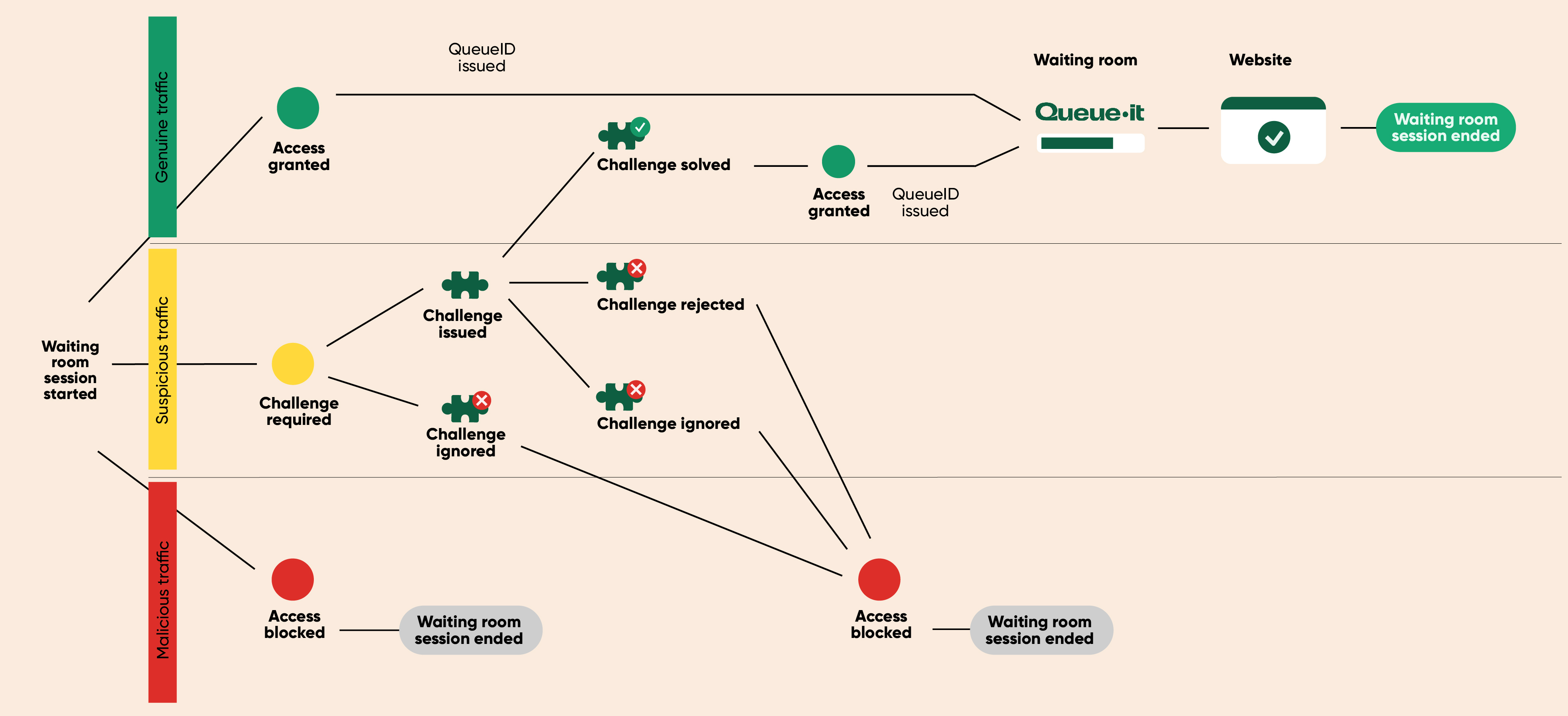
The virtual waiting room acts as a security checkpoint. You can control who this checkpoint allows through to your site by configuring customizable access rules and challenges, including:
- Enqueue Token: Ensures all visitors pass through your bot protection before joining the queue.
- Anomaly Detection: Identifies suspicious behavior and request patterns in real time.
- 24/7 Bot Protection: Blocks bots without JavaScript via splash pages in Peak Protection mode.
- Reputation Scores: Dynamically challenge or block traffic based on risk level.
- Traffic Challenges: Use CAPTCHA or Proof-of-Work to challenge automated traffic.
- Data Center Blocking: Automatically challenge or block known data center traffic.
- Traffic Access Rules: Configure up to 100 rules based on IP address, ASN, and more.
- Visitor Identification: Limit one queue spot per person using email, login, or other identifiers.
- Entry Restrictions: Require challenges before entering the queue.
- Invite-only Waiting Room: Gate access using unique links or two-factor authentication.
- IP Binding: Validate that the same visitor enters and exits the queue.
- Transaction Validation: Confirm visitor has passed through queue before checkout via API.
- Scheduled Waiting Room: Randomize arrivals to eliminate speed advantages.
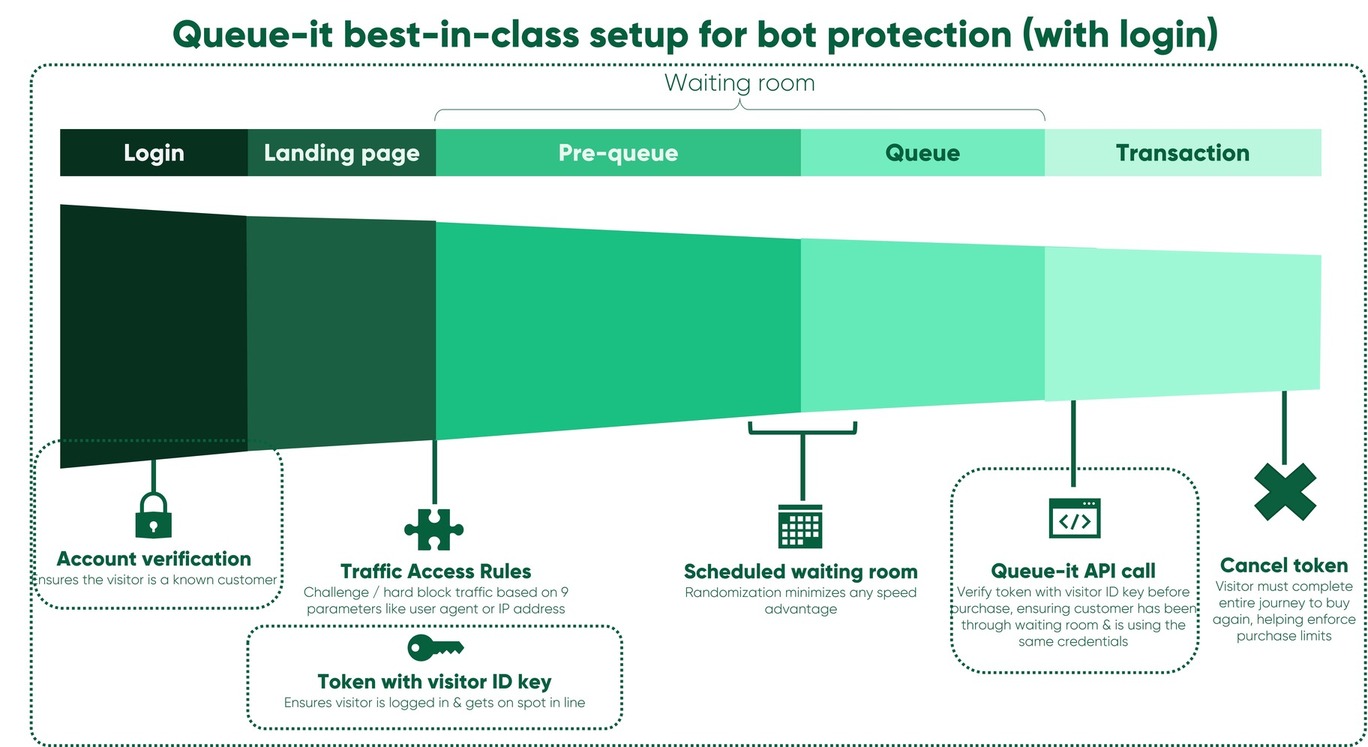
If your sale or registration is set to start at a specific time, Queue-it collects visitors on a pre-queue page with a countdown to the sale start. When the countdown hits zero and the sale starts, all visitors in the pre-queue are randomized, just like a raffle, then given a position in queue. Anyone arriving after the sale start gets a first-come, first-served spot in the online queue.
This randomization process restricts the speed advantage bots have during limited-inventory sales, where they can typically checkout in a flash. When combined with other tools to ensure only one position in queue per visitor, it levels the playing field for genuine visitors.
Queue-it is most commonly used to block bots during peak demand events such as product drops and ticket onsales. But Queue-it also offers 24/7 protection against bots and can be set-up to automatically trigger a waiting room to protect your site or app during unexpected spikes in genuine or bot traffic.
You can integrate Queue-it with a client-side, server-side, edge, or mobile SDK connector. Queue-it offers over 25 connectors and dedicated support staff for implementation.
Yes, Queue-it can be used on mobile devices and integrated into iOS, Android, Cordova, or React Native app frameworks. Visitors on a desktop can even transfer their position in queue to their mobile device if they need to queue on the go.
A virtual waiting room is a cloud-based service that empowers organizations to prevent website crashes and slowdowns by controlling traffic surges to their sites or apps.
Virtual waiting room software keeps sites running smoothly during peak demand by redirecting visitors to an online queue, before flowing them back to the website at the rate you choose.
Virtual waiting rooms work by redirecting site visitors to an online waiting room when they exceed your website's capacity using a HTTP 302 redirect. Visitors experience a short, informed wait, then are flowed back to your site or app in a controlled, first-in, first-out order.
By controlling the rate at which visitors get access to your site, you can prevent issues caused by spikes in traffic, such as site crashes, slowdowns, errors, and overselling.
- VIP-Kund:innen-, Treueprogramm- oder exklusive Mitglieder-Verkäufe
- Verkaufsaktionen mit begrenztem Bestand
- Ticket-Vorverkäufdggdeggdegggdegdehefee
- Hochkdefrdufirhfhkjdkarätige Ticket-Vorverkäufe
Run high-traffic sales & registrations without crashes or bots
Control peak traffic with a virtual waiting room to support your critical infrastructure and deliver a reliable, fair, and transparent online experience—no matter the demand











Peak traffic without Queue-it
❌ Scaling costs surge exponentially
❌ Bottlenecks fail, causing crashes & overselling
❌ Customers miss out as bots snatch up product
❌ Frustrating online experiences shatter brand trust
Peak traffic with Queue-it
✅ Organizations save 33% on database scaling
✅ 85% of customers sell product more efficiently
✅ 85% of customers say their sales are fairer
✅ 84% say their online experience improved
- Prevent crashes, slowdowns & overselling with real-time control over the flow of traffic to your site
- Protect any part of your site—from your PLP to your "Add to Cart" action to your APIs
- Get 24/7 protection for unexpected traffic peaks, triggering the waiting room only when it’s needed
- Replace frustrating performance problems with smooth, orderly sales & registrations
- Ensure fair access with first-in-first-out, randomization & prioritization mechanisms
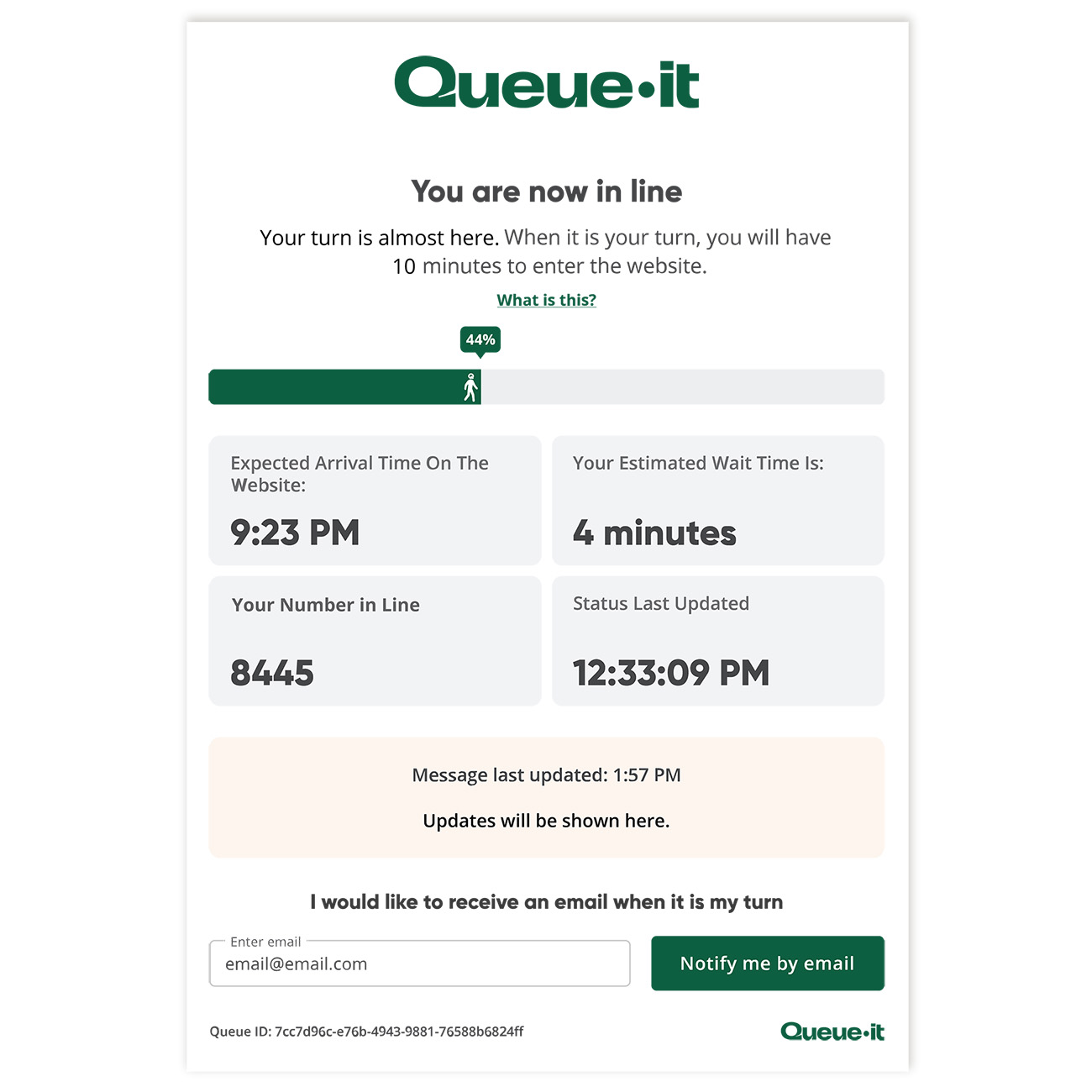
- Give customers peace of mind with transparent info like place in line & estimated wait time
- Use the virtual waiting room as a security checkpoint to slow down, block & challenge bots before they hit your site or app
- Remove bots’ speed & volume advantages with “live raffle" randomization & unique visitor identifiers
- Tailor your bot mitigation to your use case with up to 100 custom Traffic Access Rules
- Avoid the exponential costs of scaling & downtime by processing visitors at the rate you choose
- Control your event with the Queue-it Platform, where you can adjust traffic flow, communicate with customers & analyze sales progress
- Handle massive traffic with your existing systems instead of re-architecting for a few traffic spikes a year
Enterprise
Custom pricing
Custom simultaneous waiting rooms
Custom visitors via queue
Custom visitors via safety net
Custom visitors/min redirected to Queue-it
Custom visitors/min sent to site
Pro
from $4099/month
2 simultaneous waiting rooms
100k visitors via queue
5M visitors via safety net
30k visitors/min redirected to Queue-it
10k visitors/min sent to site
Standard
from $1699/month
1 simultaneous waiting room
15k visitors via queue
1M visitors via safety net
30k visitors/min redirected to Queue-it
10k visitors/min sent to site
Starter
from $499/month
1 simultaneous waiting room
5k visitors via queue
500k visitors via safety net
30k visitors/min redirected to Queue-it
10k visitors/min sent to site
| Traffic control | ||||
| Scheduled event | ✔ | ✔ | ✔ | ✔ |
| 24/7 peak protection | ✔ | ✔ | ✔ | ✔ |
| Invite-only access | ✔ | ✔ | ✔ | ✖ |
| API | ✔ | ✔ | ✖ | ✖ |
| Traffic Insights & Reporting | ✔ | ✔ | ✖ | ✖ |
| Native app connectors (Android / iOS) | ✔ | ✔ | ✔ | ✖ |
| Bots & abuse management | ✔ | ✔ | ✔ | ✖ |
| Queuing based on 6 triggers | ✔ | ✔ | ✔ | ✖ |
| User experience | ||||
| Dynamic messaging | ✔ | ✔ | ✔ | ✔ |
| 50+ languages | ✔ | ✔ | ✔ | ✔ |
| Custom theme | ✔ | ✔ | ✔ | ✔ |
| White label | ✔ | ✔ | ✔ | ✖ |
| Visitor email notifications | ✔ | ✔ | ✔ | ✖ |
| Admin | ||||
| Unlimited user accounts | ✔ | ✔ | ✔ | ✔ |
| Single sign-on | ✔ | ✔ | ✖ | ✖ |
| Platform notifications & logs | ✔ | ✔ | ✔ | ✖ |
| Load test | ✔ | ✔ | ✔ | ✖ |
| Technical support | ||||
| Enterprise SLA | ✔ | ✔ | ✖ | ✖ |
| Professional services | ✔ | ✖ | ✖ | ✖ |
| Integration support | ✔ | ✔ | ✔ | ✖ |
| Dedicated onboarding support | ✔ | ✔ | ✔ | ✔ |
| On-call staff for your events | ✔ | ✔ | ✔ | ✔ |
import React, { useMemo, useState } from "react"; import { motion } from "framer-motion"; import { Card, CardContent, CardHeader, CardTitle, } from "@/components/ui/card"; import { Button } from "@/components/ui/button"; import { Label } from "@/components/ui/label"; import { Input } from "@/components/ui/input"; import { Switch } from "@/components/ui/switch"; import { Progress } from "@/components/ui/progress"; import { Tooltip, TooltipContent, TooltipProvider, TooltipTrigger, } from "@/components/ui/tooltip"; import { BarChart, Bar, XAxis, YAxis, Tooltip as RechartsTooltip, ResponsiveContainer, Legend, } from "recharts"; import { Info, Mail, ShieldCheck, TrendingUp } from "lucide-react"; // --- Helper functions --- const toNumber = (v: string | number) => { const n = typeof v === "number" ? v : parseFloat((v || "").toString().replace(/,/g, "")); return Number.isFinite(n) ? n : 0; }; const pctToDecimal = (v: string | number) => toNumber(v) / 100; // --- Main Component --- export default function LeadMagnetVirtualWaitingRoom() { const [step, setStep] = useState<1 | 2 | 3>(1); // Step 1: Inputs const [monthlyTraffic, setMonthlyTraffic] = useState("1,000,000"); const [peakEventsPerYear, setPeakEventsPerYear] = useState("6"); const [visitorsPerPeakEvent, setVisitorsPerPeakEvent] = useState("250,000"); const [offPeakCR, setOffPeakCR] = useState("3.0"); // % const [onPeakCR, setOnPeakCR] = useState("1.8"); // % const [includeRevenue, setIncludeRevenue] = useState(false); const [aov, setAov] = useState("75"); // currency // Step 2: Lead Capture const [name, setName] = useState(""); const [email, setEmail] = useState(""); const [company, setCompany] = useState(""); const [role, setRole] = useState(""); const [region, setRegion] = useState(""); const [consent, setConsent] = useState(false); const emailValid = useMemo(() => /.+@.+\..+/.test(email), [email]); const canContinueFromInputs = useMemo(() => { return ( toNumber(monthlyTraffic) > 0 && toNumber(peakEventsPerYear) >= 0 && toNumber(visitorsPerPeakEvent) > 0 && toNumber(offPeakCR) > 0 && toNumber(onPeakCR) >= 0 && (!includeRevenue || toNumber(aov) > 0) ); }, [monthlyTraffic, peakEventsPerYear, visitorsPerPeakEvent, offPeakCR, onPeakCR, includeRevenue, aov]); const canSeeResults = useMemo(() => name && emailValid && company && consent, [name, emailValid, company, consent]); // --- Calculations --- const calc = useMemo(() => { const monthly = toNumber(monthlyTraffic); const events = toNumber(peakEventsPerYear); const visitorsPerEvent = toNumber(visitorsPerPeakEvent); const crOff = pctToDecimal(offPeakCR); const crOn = pctToDecimal(onPeakCR); // Current state (on-peak as entered) const currentPerEventConversions = visitorsPerEvent * crOn; const potentialPerEventConversions = visitorsPerEvent * crOff; // if peak performed like off-peak const deltaPerEvent = Math.max(0, potentialPerEventConversions - currentPerEventConversions); const annualDeltaConversions = deltaPerEvent * events; const monthlyBaseConversions = monthly * crOff; // rough reference only const revenue = includeRevenue ? { currentPerEventRevenue: currentPerEventConversions * toNumber(aov), potentialPerEventRevenue: potentialPerEventConversions * toNumber(aov), deltaPerEventRevenue: deltaPerEvent * toNumber(aov), annualDeltaRevenue: annualDeltaConversions * toNumber(aov), } : undefined; const chartData = [ { name: "On-peak now", Conversions: Math.round(currentPerEventConversions), }, { name: "If peak = off-peak", Conversions: Math.round(potentialPerEventConversions), }, ]; return { currentPerEventConversions, potentialPerEventConversions, deltaPerEvent, annualDeltaConversions, monthlyBaseConversions, revenue, chartData, }; }, [monthlyTraffic, peakEventsPerYear, visitorsPerPeakEvent, offPeakCR, onPeakCR, includeRevenue, aov]); // --- UI helpers --- const StepBadge = ({ n, label, active }: { n: number; label: string; active: boolean }) => (
); const nextFromStep1 = () => { if (canContinueFromInputs) setStep(2); }; const nextFromStep2 = () => { if (canSeeResults) setStep(3); }; return (
Peak Readiness Calculator
An interactive tool for high‑demand sales and registrations. Estimate how much you could gain by making peak conversion match your off‑peak conversion. Built for virtual waiting room scenarios.
Total sessions across your site/app in a typical month.
Major drops, sales, registrations, or announcements that drive surges.
Typical conversion when systems are calm.
Observed conversion during high demand today.
Used to estimate revenue impact.
Enter a valid email.
)}Your on‑peak conversion is below your off‑peak conversion. A virtual waiting room helps keep systems reliable when demand surges, so peaks can convert like calm periods. The estimates above compare your current on‑peak performance to a scenario where peak conversion matches your off‑peak rate.
Use these results to size the business case and guide your peak protection strategy. Want a tailored model (e.g., by product category, registration type, or queue rules)? Reply to the results email and we’ll help you refine it.
)}); } function StatBox({ label, value, money = false, highlight = false }: { label: string; value: number; money?: boolean; highlight?: boolean }) { const display = money ? Intl.NumberFormat(undefined, { style: "currency", currency: "USD", maximumFractionDigits: 0 }).format(Math.round(value || 0)) : Math.round(value || 0).toLocaleString(); return (
); } function KV({ label, value }: { label: string; value: string }) { return (
); }